Thymosin Beta 4 and Its Actin-Binding Fragment — Two Distinct Molecules
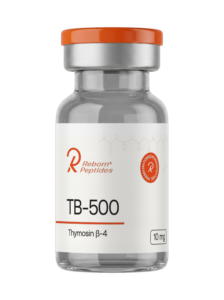
Thymosin beta 4 is a naturally occurring, actin-sequestering peptide encoded by the TMSB4X gene. Its mature form contains 43 amino-acid residues. It must be distinguished from the N-terminally acetylated 17-23 fragment Ac-LKKTETQ: the full peptide and this seven-residue fragment are chemically different molecules. Most of the published biology discussed here concerns full-length thymosin beta 4, so material identity must come before interpretation.
The materials discussed are for laboratory research use only. They are not for human or veterinary use. This page is an identity and evidence guide. Background pages cover what peptides are and collect peptide research basics.
Three related molecules that must not be conflated
- Thymosin beta 4 (Tβ4) — Natural, actin-sequestering 43-residue peptide; gene TMSB4X — 4963 Da — Main subject of the published biology
- TB-500 in doping-control literature — N-terminally acetylated Tβ4 fragment spanning residues 17-23, Ac-LKKTETQ — 889 Da (calculated) — Identified analytically in a TB-500 preparation; the doping-control target
- Ac-SDKP — N-acetyl-Ser-Asp-Lys-Pro, an N-terminal tetrapeptide fragment of Tβ4 — 487 Da — Has a distinct literature and is not Ac-LKKTETQ
Esposito 2012 identified Ac-LKKTETQ in a TB-500 preparation and synthesised it (analytical and synthetic chemistry, no biological model; PMID 22962027), and Ho 2012 detected it in equine samples (in vitro plus equine model, analytical; PMID 23084823); the analytics chapter sets both out. Ac-SDKP is released from Tβ4 by sequential cleavage involving meprin-alpha and prolyl oligopeptidase (in vitro plus rat/mouse models; PMID 26962108; DOI 10.1152/ajprenal.00562.2015). These observations define three separate molecular assignments.
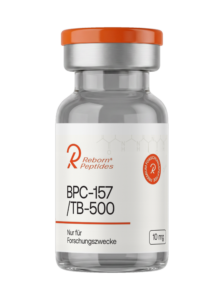
Commercial wording alone does not establish molecule identity. Batch-linked documentation, including the Certificate of Analysis, is decisive. The link to the research material in the catalogue does not equate that material with either molecule solely on the basis of its name. The principles behind HPLC and MS purity analysis also keep identity evidence separate from a batch-specific purity result.
Technical identifiers for the full peptide
The identifiers for full thymosin beta 4 are UniProt P62328, CAS 77591-33-4, molecular formula C212H350N56O78S and PubChem CID 16132341. Registers and publications write the name in several ways — thymosin beta-4, thymosin b4 and Tβ4 all denote this same full-length peptide, and the hyphen carries no chemical meaning. The mature, N-terminally acetylated 43-residue peptide has a mass of approximately 4963 Da. Its sequence is:
Ac-SDKPDMAEIEKFDKSKLKKTETQEKNPLPSKETIEQEKQAGES
LKKTETQ corresponds to residues 17-23. UniProt’s approximately 5053 Da value describes the 44-residue translation chain with the initiator methionine and without N-terminal acetylation. Removing that methionine and accounting for acetylation gives the approximately 4963 Da mature form. The values therefore describe different sequence states, not a contradiction.
No confirmed, generally accepted CAS or PubChem entry is available for the fragment in the source record used here, and none is supplied on this page. The approximately 889 Da quoted for Ac-LKKTETQ is calculated from its sequence (C38H68N10O14), not taken from a register. A name, a calculated mass and a register identifier are different evidence fields.
Actin sequestration as the core biochemical mechanism
The central thymosin beta 4 function in the cited biochemical work is its interaction with actin. Full Tβ4 bound muscle G-actin monomers in a 1:1 ratio and inhibited salt-induced actin polymerisation (in vitro; PMID 1999398). That 1:1 thymosin beta 4 actin stoichiometry is the earliest finding in this source set and the reference point for everything that follows.
Synthetic Tβ4 microinjected into living epithelial cells and fibroblasts was associated with fewer stress fibres and concentration-dependent depolymerisation of actin filaments (in vitro; PMID 1584803; DOI 10.1073/pnas.89.10.4678). Both findings concern full Tβ4 in bounded biochemical or cell systems; neither establishes a result in humans nor applies to Ac-LKKTETQ.
A short-form label such as tb4 peptide places a material in the family without identifying what was used in a given experiment. Sequence, terminal modification and batch record remain necessary.
Directional cell migration in an endothelial model
Malinda 1997 examined human umbilical vein endothelial cells (HUVECs) in a Boyden chamber and reported a four- to sixfold increase in directional migration with Tβ4 as a chemoattractant; a Matrigel-plug experiment in vivo supported the cell finding (in vitro plus in vivo Matrigel plug, host species not stated in the abstract; PMID 9194528; DOI 10.1096/fasebj.11.6.9194528). The observation belongs to that endothelial model and its defined endpoint.
Directional migration, actin binding and collagen deposition are separate endpoints and not interchangeable. The guide to in vitro and animal study models explains why the model qualifier remains attached to every observation.
Tissue remodelling endpoints in preclinical models
Full Tβ4 was examined in a rat full-thickness wound model, where reepithelialisation rose by 42 per cent over saline controls at four days and by as much as 61 per cent at seven days, and separately in a keratinocyte Boyden-chamber assay, where migration rose two- to threefold over medium alone (rat model plus in vitro; PMID 10469335; DOI 10.1046/j.1523-1747.1999.00708.x). The findings are limited to those experimental settings.
Philp 2003 examined full Tβ4 in db/db diabetic mice, in aged mice and in normal rats. The endpoint results belong to full Tβ4, not to the fragment: in the diabetic mice wound contraction and collagen deposition rose while keratinocyte migration showed no difference, and in the aged mice all three rose (db/db and aged mouse models plus normal rats; PMID 12581423; DOI 10.1046/j.1524-475x.2003.11105.x). Separately, a synthetic seven-residue peptide reproducing the actin-binding domain, reported simply as LKKTETQ, promoted repair in the aged animals, described as comparable to the parent molecule and without any breakdown by endpoint. The record does not state that peptide’s terminal chemistry, and it reports no fragment result for the db/db or normal-rat arms. It is the only paper in the source set that concerns the heptapeptide.
That comparison does not make full Tβ4 and Ac-LKKTETQ interchangeable, and it sits one step further away than it looks: that experiment names the heptapeptide only as LKKTETQ and does not state its terminal chemistry, while the trade name and the doping-control literature concern the N-terminally acetylated Ac-LKKTETQ. A comparable overall repair result in one aged-mouse arm is narrower than molecular equivalence.
Why the trade name appears in doping-control analytics
The trade name appears because targeted analytical methods were developed for Ac-LKKTETQ. Esposito 2012 identified the N-terminally acetylated fragment in a TB-500 preparation by HPLC with high-resolution mass spectrometry, synthesised it by solid-phase peptide synthesis, and proposed — but did not run — a triple-quadrupole LC-MS/MS strategy for plasma and urine (analytical and synthetic chemistry, no biological model; PMID 22962027; DOI 10.1002/dta.1402). Ho 2012 identified the metabolites in vitro first, then detected Ac-LKKTETQ and those metabolites in equine plasma and urine collected from horses after administration; the confirmation levels of 0.02 ng/mL in plasma and 0.01 ng/mL in urine are reported for Ac-LKKTETQ itself, not its metabolites (in vitro plus equine model, analytical; PMID 23084823; DOI 10.1016/j.chroma.2012.09.043).
This literature addresses synthesis, characterisation and detection. It does not establish biological performance. This section is not legal advice and makes no statement about legal status.
What does not follow from this evidence base
The source set does not establish which molecule is present in an arbitrarily trade-named product; literature and supplier terminology are not consistently aligned (PMID 22962027; PMID 23084823). Batch documentation must resolve the question.
Nearly all cited biological work concerns full Tβ4. Only Philp 2003 concerns the heptapeptide in this source set, and there without any statement of its terminal chemistry and only in the aged-mouse arm (db/db and aged mouse models plus normal rats; PMID 12581423). The cited record contains cell, animal and analytical models and no human study. No observation from a rat or mouse wound model becomes a statement about humans (rat model, PMID 10469335; mouse and rat models, PMID 12581423).
Likewise, the comparable overall repair reported for full Tβ4 and the heptapeptide in the aged-mouse arm does not establish general transferability between them (db/db and aged mouse models; PMID 12581423). A defensible reading preserves molecule, model and endpoint together.
Frequently asked questions
1. Is TB-500 the same as thymosin beta 4?
Not necessarily. In the anti-doping literature the name denotes Ac-LKKTETQ, calculated at approximately 889 Da from its sequence (analytical and synthetic chemistry; PMID 22962027; DOI 10.1002/dta.1402), while some suppliers use it for full Tβ4 at approximately 4963 Da.
2. What is the thymosin beta 4 sequence?
The mature sequence is Ac-SDKPDMAEIEKFDKSKLKKTETQEKNPLPSKETIEQEKQAGES: 43 residues with N-terminal acetylation (UniProt P62328).
3. What is the LKKTETQ motif?
It is the actin-binding region at residues 17-23 of mature Tβ4; that assignment is stated in the doping-control record (in vitro plus equine model; PMID 23084823). Its N-terminally acetylated fragment is Ac-LKKTETQ (analytical and synthetic chemistry; PMID 22962027; DOI 10.1002/dta.1402).
4. What is the core biochemical mechanism studied?
Full Tβ4 binds G-actin 1:1 and affects its polymerisation (in vitro; PMID 1999398; PMID 1584803; DOI 10.1073/pnas.89.10.4678).
5. Why does the trade name occur in doping-control studies?
Researchers identified the fragment in a preparation, synthesised it, and developed LC-MS detection methods (analytical and synthetic chemistry, PMID 22962027; in vitro plus equine model, PMID 23084823).
6. Why is no CAS number given for the fragment?
The source record has no confirmed identifier from an authoritative register. An unverified number would confuse rather than establish analytical assignment.
7. Which model types dominate this literature?
In vitro biochemistry, cell assays, analytical methods and animal models dominate. This source set contains no human study.
8. Can one general conclusion be drawn for both molecules?
No. Substance identity must be established first. This source set compares them in the aged-mouse arm of a single study, and there with a heptapeptide whose terminal chemistry the record does not state (mouse and rat models; PMID 12581423).
Sources
- Esposito et al., 2012 — Identification in a TB-500 preparation and synthesis of the N-terminally acetylated Tβ4 fragment 17-23 — PMID 22962027; DOI 10.1002/dta.1402 — Analytical and synthetic chemistry (no biological model)
- Ho et al., 2012 — Ac-LKKTETQ and metabolites in equine plasma and urine by LC-MS — PMID 23084823; DOI 10.1016/j.chroma.2012.09.043 — In vitro plus equine model, analytical
- Safer, Elzinga and Nachmias, 1991 — G-actin binding and salt-induced actin polymerisation — PMID 1999398; no DOI — In vitro
- Sanders, Goldstein and Wang, 1992 — Tβ4 and actin polymerisation in living cells — PMID 1584803; DOI 10.1073/pnas.89.10.4678 — In vitro
- Malinda, Goldstein and Kleinman, 1997 — Directional migration of human endothelial cells — PMID 9194528; DOI 10.1096/fasebj.11.6.9194528 — In vitro (HUVEC) plus in vivo Matrigel plug; host species not stated
- Malinda et al., 1999 — Full-thickness wounds and keratinocytes — PMID 10469335; DOI 10.1046/j.1523-1747.1999.00708.x — Rat model plus in vitro
- Philp et al., 2003 — Full Tβ4 and a synthetic LKKTETQ peptide — PMID 12581423; DOI 10.1046/j.1524-475x.2003.11105.x — db/db and aged mouse models plus normal rats
- Kumar et al., 2016 — Ac-SDKP release from Tβ4 by meprin-alpha and prolyl oligopeptidase — PMID 26962108; DOI 10.1152/ajprenal.00562.2015 — In vitro plus rat/mouse models