≥ 99 % · HPLC
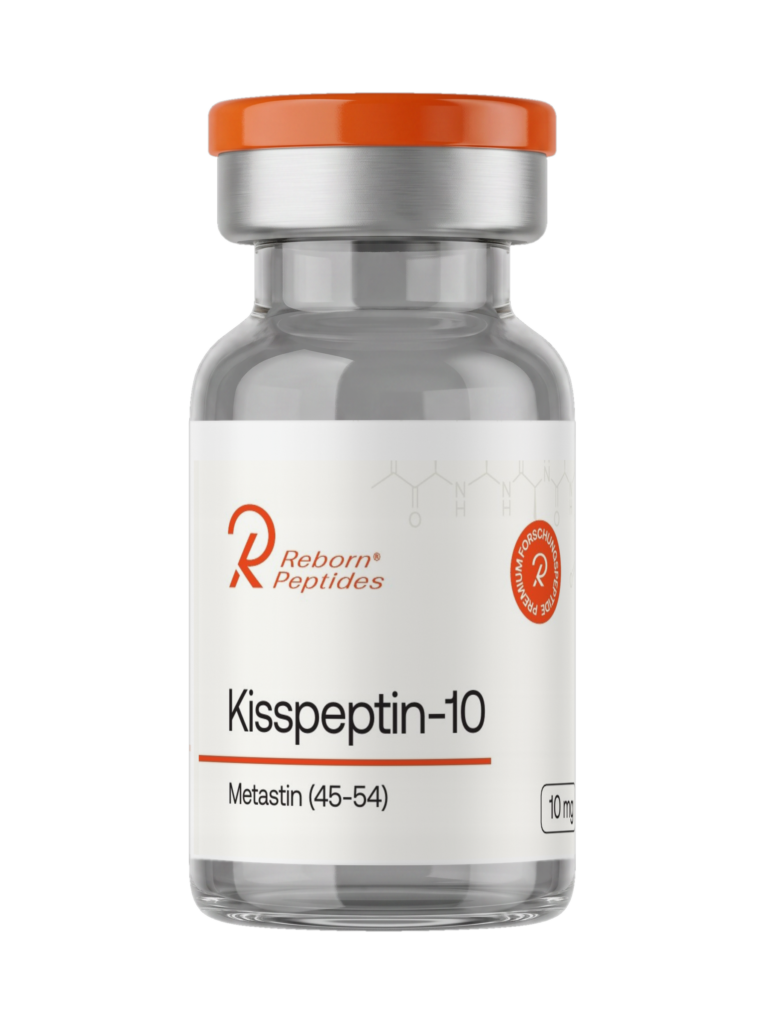
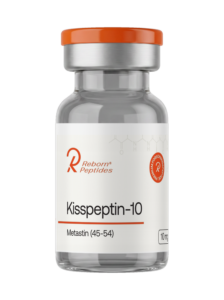
Kisspeptin-10
Libido & Sexual Function
50,90 €

50,90 €
incl. shipping & VAT

Certificate of analysis per batch

≥ 99 % purity (HPLC)

Shipping across the EU

Delivery in 3–5 business days
Strength: 5 mg
Quantity:

Fast & secure payment
Bacteriostatic water 10 ml
For reconstitution — included free with orders over €70.
Only 70,00 € until your free gift.

What is AOD-9604
AOD-9604 is a synthetic 16-residue peptide and the N-tyrosyl analogue of hGH fragment 177–191. Its additional N-terminal tyrosine and closed disulphide bond distinguish it from unmodified hGH Fragment 176-191; the two substances must not share identity records or batch documentation.
Published research includes defined receptor and cell assays, mouse and rat models, and secondary literature. Every observation remains limited to the reported molecule, model, method, comparator and endpoint. AOD-9604 is supplied strictly for laboratory research and is not for use in humans or animals.
Laboratories intending to buy AOD 9604 should match the catalogue code, label, batch code and COA to the same material before procurement.
AOD-9604 is structurally related to the C-terminal region of human growth hormone, but structural ancestry does not make it equivalent to full-length hGH or unmodified hGH Fragment 176-191. The catalogue forms AOD-9604, AOD9604 and AOD 9604 refer to the modified analogue described here, and the shortened trade usage “AOD peptide” names the same analogue rather than a compound class.
The cited evidence spans several levels. Receptor-competition and receptor-dependent cell-proliferation assays examined defined molecular events in vitro. Separate mouse and rat studies measured specified whole-animal, tissue and molecular endpoints under their reported conditions. A review provides secondary context without replacing the primary experiments.
These findings do not establish the identity, content, salt form, purity, stability or experimental suitability of a supplied batch. Procurement review should connect the AOD-9604 designation, catalogue code, label, batch code, test date and COA. Third-party listings differ in declared fill content, so a quantity read from such a listing describes that listing alone and never documents what a supplied vial contains. HPLC reports a method-specific chromatographic result for the tested batch, while suitable mass-spectrometry documentation can support molecular-mass assignment.
Binding storage and handling conditions follow the applicable label, specification and batch documentation. No batch-independent temperature or purity value is asserted.
Unmodified HGH Fragment 176-191 remains a separate catalogue record with its own identity and documentation: /en/products/hgh-fragment-176-191/. AOD-9604 is exclusively for laboratory research and is not intended for human or veterinary use.

Evidence
AOD-9604 was examined in obese-mouse and beta3-adrenergic-receptor knockout mouse models using body-mass, tissue and receptor-RNA endpoints. These observations remain specific to the reported designs.
Heffernan et al. 2001 · PMID 11713213
A synthetic hGH terminal domain was examined in obese Zucker rats using body-mass, adipose-tissue and insulin-sensitivity measurements. These endpoints do not transfer beyond that animal model.
Ng et al. 2000 · PMID 11146367
In the reported in-vitro component, AOD-9604 did not compete for the hGH receptor or induce hGH-receptor-dependent cell proliferation. This does not establish the absence of every possible interaction.
Heffernan et al. 2001 · PMID 11673763
A review places AOD-9604 within wider pharmacological literature but does not establish the identity or properties of a supplied batch.
Misra et al. 2013 · PMID 23092275
Identity and any numerical purity result require linkage to the applicable batch, analytical method and COA.
Reborn batch documentation · COA with HPLC and MS
Research status
4 selected sources — filterable by study type, each linking straight to the source.
Research Deep Dive
Model-qualified findings in depth — every claim tied to a PubMed-indexed source.
AOD-9604 is a synthetic 16-residue peptide described as the N-tyrosyl analogue of the C-terminal region 177–191 of human growth hormone. Its reference sequence is YLRIVQCRSVEGSCGF. The N-terminal tyrosine is a synthetic addition, and the reference structure contains a disulphide bridge between the two cysteine residues. These features describe the literature identity; they do not authenticate a supplied batch.
| Field | Reference specification |
|---|---|
| Name | AOD-9604 |
| Code | to be reconciled against released label, specification and batch documentation |
| Originator | to be reconciled against released label, specification and batch documentation |
| Class | N-tyrosyl analogue of the hGH C-terminal region 177–191 |
| Length | 16 amino-acid residues |
| Sequence | YLRIVQCRSVEGSCGF |
| Structural feature | Disulphide bridge between the two cysteines |
| Target profile | Receptor, cell and metabolic-endpoint research in specified experimental models |
| Molecular formula | C78H123N23O23S2, free 16-mer with closed disulphide bond |
| Molecular mass | 1815.1 g/mol, average mass of the free form |
| CAS identifier | 221231-10-3; the deprecated record 386264-39-7 also circulates |
| PubChem CID | 71300630 |
| Fill quantity and salt form | to be reconciled against released label, specification and batch documentation |
| Storage conditions | to be reconciled against released label, specification and batch documentation |
Formula, mass and registry identifiers above belong to the AOD-9604 record itself and are never inherited from the related fragment; the two differ at their first residue and therefore carry different formulae, masses and CAS records. Sequence identity, disulphide connectivity, content and chromatographic purity are separate analytical questions. A method-specific HPLC result can describe only the tested sample and batch; it is not a universal purity statement for AOD-9604.
Identity and model sources: Heffernan et al. 2001 · PMID 11713213 · Heffernan et al. 2001 · PMID 11673763
Structural ancestry does not establish the signalling profile of intact hGH. The cited work therefore treats receptor behaviour, cellular response and whole-animal measurements as separate research levels. Each result remains conditional on its assay, comparator, species, timing and endpoint.
One mixed study reported that AOD-9604 did not compete for the hGH receptor in its tested in vitro system. This negative result defines that assay boundary, not every possible molecular interaction.
The same work reported no induction of hGH-receptor-dependent cell proliferation under the stated conditions. A cell readout cannot be converted into a whole-organism conclusion.
Mouse and rat studies measured metabolic, tissue and receptor-expression endpoints. Those observations remain preclinical and species-bound.
Heffernan and colleagues used obese mice and β3-adrenergic-receptor knockout mice to examine pathway-related variables, including receptor RNA expression and differences between acute and chronic experimental conditions. Ng and colleagues examined a synthetic hGH terminal domain in obese Zucker rats. These designs can test relationships inside named models, but they neither certify a commercial material nor establish equivalence with full-length hGH.
Mechanism sources: Heffernan et al. 2001 · PMID 11713213 · Ng et al. 2000 · PMID 11146367 · Heffernan et al. 2001 · PMID 11673763
This section describes findings in controlled research and makes no statement about use. The evidence consists of in vitro components, animal models and one secondary review. It does not constitute human intervention evidence, and no publication listed here analyses a Reborn Peptides batch.
An obese Zucker-rat study measured body-mass gain, adipose-tissue lipolytic activity and insulin-sensitivity variables for a synthetic hGH terminal domain. The observations are limited to that preclinical design.
PMID 11146367 · DOI 10.1159/000053183Obese and β3-adrenergic-receptor knockout mouse models were used to measure body-mass, tissue and receptor-expression endpoints under reported acute and chronic conditions.
PMID 11713213 · DOI 10.1210/endo.142.12.8522Obese and lean mouse models were paired with in vitro receptor-competition and receptor-dependent proliferation assays. Animal and cellular endpoints must remain analytically separate.
PMID 11673763 · DOI 10.1038/sj.ijo.0801740This secondary review places AOD-9604 within broader pharmacological literature. It maps prior research but is not a primary experiment and does not add batch evidence.
PMID 23092275 · DOI 10.2174/157340313805076322Evidence map: PMID 11146367 · PMID 11713213 · PMID 11673763 · PMID 23092275
AOD-9604 and unmodified hGH Fragment 176-191 are two different substances. AOD-9604 has the 16-residue sequence YLRIVQCRSVEGSCGF, beginning with synthetic N-terminal tyrosine (Y). The native fragment has the sequence FLRIVQCRSVEGSCGF, beginning with phenylalanine (F) at hGH residue 176. The difference is exactly at the first residue: synthetic tyrosine versus native phenylalanine.
This one-residue distinction has direct analytical and procurement consequences. The label, product code, batch code, specification, analytical method and COA must all point to the same material. Sequence-derived identifiers and batch documents for the two substances must never be exchanged. In particular, molecular formula, molecular mass and CAS data must not be inherited in either direction.
The shortened form “aod peptide” refers here only to AOD-9604, not to a peptide class. Shared ancestry at the hGH C-terminus does not make the substances synonyms and does not permit experimental findings or analytical records to cross between them. The separate record for HGH Fragment 176-191 preserves that distinction.
Delimitation sources: Heffernan et al. 2001 · PMID 11713213 · Heffernan et al. 2001 · PMID 11673763
No fill quantity, salt form or storage condition is asserted here. Each must be reconciled against the released label, specification and documentation for the applicable batch. Third-party listings place 2 mg and 5 mg presentations alongside one another, but an amount read from one such listing describes that listing alone and cannot document another supplied material.
Laboratories intending to buy aod 9604 should require a traceable chain connecting product designation, product code, label, batch code, specification, analytical method, test date, result and COA. Any inconsistency should be resolved before material is assigned to a controlled study. A numerical HPLC purity result is method- and batch-specific; chromatography alone does not establish the complete sequence or disulphide connectivity.
Published studies address research materials and experimental models, while released analytical documents address a named sample. Neither document type substitutes for the other. Identity statements and any purity value therefore require evidence tied to the same batch.
Analytical context source: Heffernan et al. 2001 · PMID 11673763
AOD-9604 is presented as research material for controlled laboratory work. The literature record is limited to the named assays, animal models, comparators and endpoints. It does not establish a human outcome, certify supplied material or replace batch-specific analytical review.
Research use only. For laboratory research only. Not for human or veterinary use. Not intended to diagnose, treat, cure or prevent any disease. Not a medicinal product, food or cosmetic.

FAQ
AOD-9604 is a synthetic 16-residue peptide described in the cited literature as the N-tyrosyl analogue of hGH fragment 177–191. It contains an additional N-terminal tyrosine and a disulphide bond between its two cysteine residues.
No. AOD-9604 is a modified analogue with an additional N-terminal tyrosine, while the unmodified fragment begins at residue 176. Their formulae, masses, CAS identifiers and batch documents must remain separate.
The cited publications include in-vitro receptor and cell assays, preclinical mouse and rat models, and a secondary review. Every observation is limited to the reported model, method, comparator and endpoint.
The product designation, catalogue code, label, batch code, specification, test date and COA should connect to the same material. Any purity result applies only to the tested batch and stated analytical method.
Strictly for laboratory research and not for use in humans or animals. Published observations are not product outcomes and do not characterise a commercial batch.
We accept prepayment by SEPA bank transfer as well as credit card. All payments are processed securely and encrypted.
Discreet shipping from the EU, delivery in 3–5 business days. Neutral packaging with no reference to the contents.