≥ 99 % · HPLC
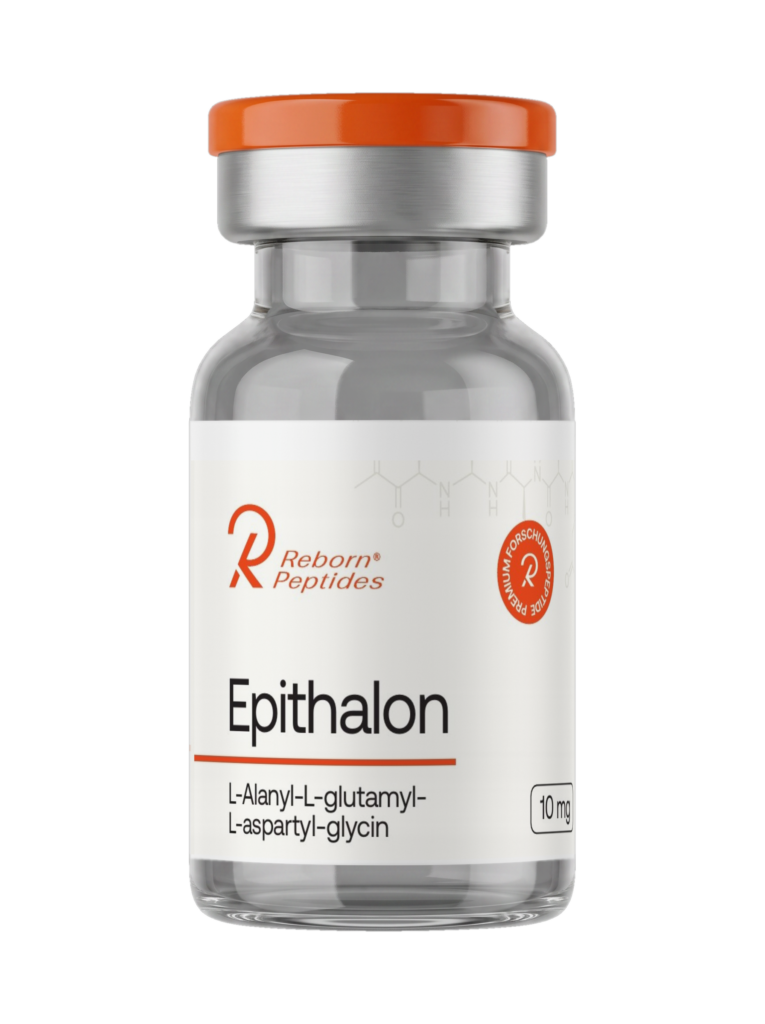
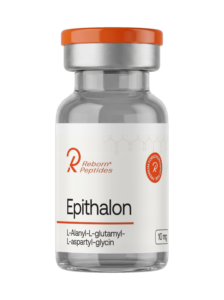
Epithalon
Regeneration & Longevity
38,90 €
59,90 €
incl. shipping & VAT

Certificate of analysis per batch

≥ 99 % purity (HPLC)

Shipping across the EU

Delivery in 3–5 business days
Strength: 10 mg
Quantity:

Fast & secure payment

Delivery: 02.11. – 03.11.
Bacteriostatic water 10 ml
For reconstitution — included free with orders over €70.
Only 70,00 € until your free gift.
 View Certificate of Analysis
Laboratory analysis
Tested by an independent EU laboratory using HPLC against a reference standard. Purity and content of the sample at a glance, full report as PDF – with a verification code to check directly with the lab.
28UJB2G0What is Retatrutide
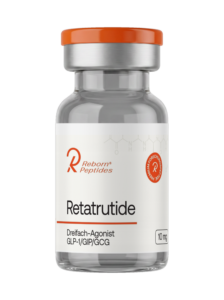
Retatrutide is a synthetic peptide of 39 amino acids and a so-called triple agonist: it activates the GIP, GLP-1 and glucagon receptors simultaneously - going one step further than the established dual agonists.
It is the substance with the most recent and highest-quality evidence base in this range: randomised, placebo-controlled phase 2 trials have been published. At Reborn Peptides, retatrutide is strictly a research peptide.
The concept behind retatrutide is the simultaneous engagement of three receptors. GLP-1 and GIP act via satiety and the insulin response, while the glucagon receptor additionally addresses energy expenditure.
The central work is the phase 2 obesity trial by Jastreboff and colleagues (2023) in the New England Journal of Medicine. In parallel, Rosenstock and colleagues (2023) examined type 2 diabetes in a randomised, double-blind, placebo- and active-controlled phase 2 trial in the Lancet.
Review articles now place the substance within its field (Abdul-Rahman and colleagues, 2024; Katsi and colleagues, 2025).
A note on the identity figures: several conflicting molecular formulas and molecular weights circulate for retatrutide, and PubChem does not list a reliable structure. We therefore show only the CAS number and the number of amino acids - and for the same reason there is no molecular graphic here.
Context: despite the strong study base, retatrutide is not an approved medicine.
Evidence
Retatrutide activates the GIP, GLP-1 and glucagon receptors. The glucagon arm additionally addresses energy expenditure.
Jastreboff et al. 2023 · PMID 37366315
Randomised, placebo-controlled phase 2 trials exist for both obesity and type 2 diabetes.
Jastreboff et al. 2023 · PMID 37366315 · Rosenstock et al. 2023 · PMID 37385280
Despite the high-quality study base, retatrutide is not approved.
Katsi et al. 2025 · PMID 40563436
Research status
4 selected sources — filterable by study type, each linking straight to the source.
Research Deep Dive
Model-qualified findings in depth — every claim tied to a PubMed-indexed source.
Retatrutide is a lipidated peptide of approximately 39 amino acids containing purposefully incorporated aminoisobutyric acid (Aib) and alpha-methyl-leucine. These non-natural residues affect conformational stability and accessibility to peptidases, both of which are relevant variables in controlled experiments.
A C20 fatty diacid is attached to a lysine side chain through a linker containing gamma-glutamate and AEEA units. This lipid anchor enables binding to serum albumin (Coskun et al. 2022; model type: preclinical). The structure therefore distinguishes retatrutide from a simple natural-peptide analogue: its receptor profile and persistence were engineered as separate molecular properties.
| Field | Specification |
|---|---|
| Substance name | Retatrutide |
| Development code | LY3437943 |
| Originator | Eli Lilly and Company |
| Substance class | Synthetic, lipidated peptide (~39 amino acids) with non-natural residues |
| Receptor profile | Agonist at GIPR, GLP-1R and GCGR |
| CAS number | 2381089-83-2 |
| Molecular formula / weight | Stated only after reconciliation with the batch COA — public sources conflict |
| Regulatory status | Investigational substance candidate; not approved by the FDA or EMA |
| Intended use | Laboratory research only |
GIPR, GLP-1R and GCGR are class B1 G-protein-coupled receptors. Although related, they differ enough in ligand recognition that a peptide will not ordinarily activate all three efficiently. “Triple agonist” describes exactly this binding and activation profile: one molecule acting at three target receptors. It does not establish an approved use or a guaranteed experimental outcome.
Glucose-dependent insulinotropic polypeptide receptor — in vitro, retatrutide shows comparatively greater activity here than at the other two receptors.
Glucagon-like peptide-1 receptor — balanced in-vitro activity, the axis shared with established single and dual agonists.
Glucagon receptor — the structurally distinguishing third arm versus dual GLP-1/GIP agonists, linked in the cited studies to energy expenditure.
Cryo-EM structures of retatrutide bound to GLP-1R, GIPR and GCGR show the peptide adopting a continuous helix. Its N-terminal segment enters each receptor’s transmembrane core, while the C-terminal region binds the extracellular domain (Li et al. 2024; model type: in-vitro cryo-EM structural biology).
Retatrutide maintains contacts with conserved residues shared across the receptors while accommodating receptor-specific differences — particularly apparent in the first extracellular loop (ECL1), which forms a rigid alpha helix in GLP-1R and GCGR but a flexible loop in GIPR. For multi-target peptide research, these structures provide a defined model for investigating which contacts contribute to receptor selectivity.
Sources: Coskun 2022 · PMID 35985340 · Li 2024, Cell Discovery · PMID 39019866
The findings below describe outcomes in controlled clinical research. They do not establish an approved use, support self-experimentation or predict an outcome outside the cited studies.
Adults with type 2 diabetes; dose-dependent changes in HbA1c and body weight reported as study endpoints versus placebo.
Urva et al. · PMID 36354040Type 2 diabetes; dose-dependent change in the HbA1c endpoint of up to ~2.0 percentage points, with placebo and active controls.
Rosenstock et al. · PMID 37385280Obesity without type 2 diabetes; mean change in the primary body-weight endpoint of ~24.2% in the highest studied arm versus ~2.1% with placebo.
Jastreboff et al. · PMID 37366315Obesity with metabolic dysfunction-associated steatotic liver disease (MASLD); large, dose-dependent relative changes in the MRI-PDFF liver-fat endpoint versus virtually unchanged values with placebo.
Sanyal et al. · PMID 38858523Forums and community sources use several informal labels for the same substance, including “Triple G”, “GLP-3” and “Reta”. The triple g peptide, the glp-3 peptide and the reta peptide therefore all describe this one material. The correct substance name is Retatrutide, and its development code is LY3437943.
“GLP-3” is scientifically misleading because there is no GLP-3 receptor. In this context, the label refers to agonism at three established receptors: GIPR, GLP-1R and GCGR (Li et al. 2024). These terms are clarified here but are not used as product names.
This retatrutide research peptide is supplied as 10 mg of lyophilised material. Batch details and the corresponding analytical documentation appear in the product data and applicable certificate of analysis (COA).
Storage and laboratory handling: Lyophilised peptides are stored dry, protected from light and refrigerated. Temperature cycling and moisture ingress are significant practical quality risks. Before a container is opened in the laboratory, it should be allowed to reach room temperature to reduce condensation inside it (Wang 2000; review of the stability and storage of lyophilised peptide preparations).
Batch documentation: Purity information is always batch-specific and is communicated only with the linked COA. This page makes no blanket purity claim.
Reborn lists retatrutide exclusively as a laboratory research material for laboratories and researchers across the EU. Seven PubMed-indexed sources — spanning The New England Journal of Medicine, The Lancet, Nature Medicine, Cell Metabolism and Cell Discovery — document the research landscape from preclinical work through phase 1b and phase 2, and every scientific claim in this section is tied to one of them.
Research use only. For laboratory research only. Not for human or veterinary use. Not intended to diagnose, treat, cure or prevent any disease. Not a medicinal product, food or cosmetic.

FAQ
A peptide of 39 amino acids that activates the GIP, GLP-1 and glucagon receptors at the same time.
A substance that activates three receptors simultaneously. Retatrutide extends the established GLP-1/GIP approach by the glucagon receptor.
Because several conflicting values circulate for retatrutide and PubChem does not list a reliable structure. We would rather show less than something wrong.
Strictly as a research peptide for laboratory use only, not for use in humans or animals. Every batch is documented with a certificate of analysis (COA), HPLC and MS.
We accept prepayment by SEPA bank transfer as well as credit card. All payments are processed securely and encrypted.
Discreet shipping from the EU, delivery in 3–5 business days. Neutral packaging with no reference to the contents.