≥ 99 % · HPLC
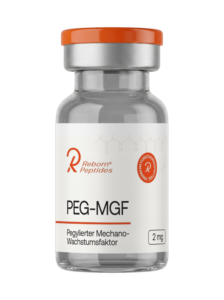
PEG-MGF
Metabolism, Weight & Muscle
45,90 €
249,00 €
incl. shipping & VAT

Certificate of analysis per batch

≥ 99 % purity (HPLC)

Shipping across the EU

Delivery in 3–5 business days
Strength: 20 mg
Quantity:

Fast & secure payment

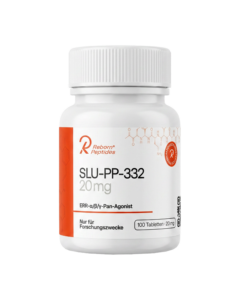
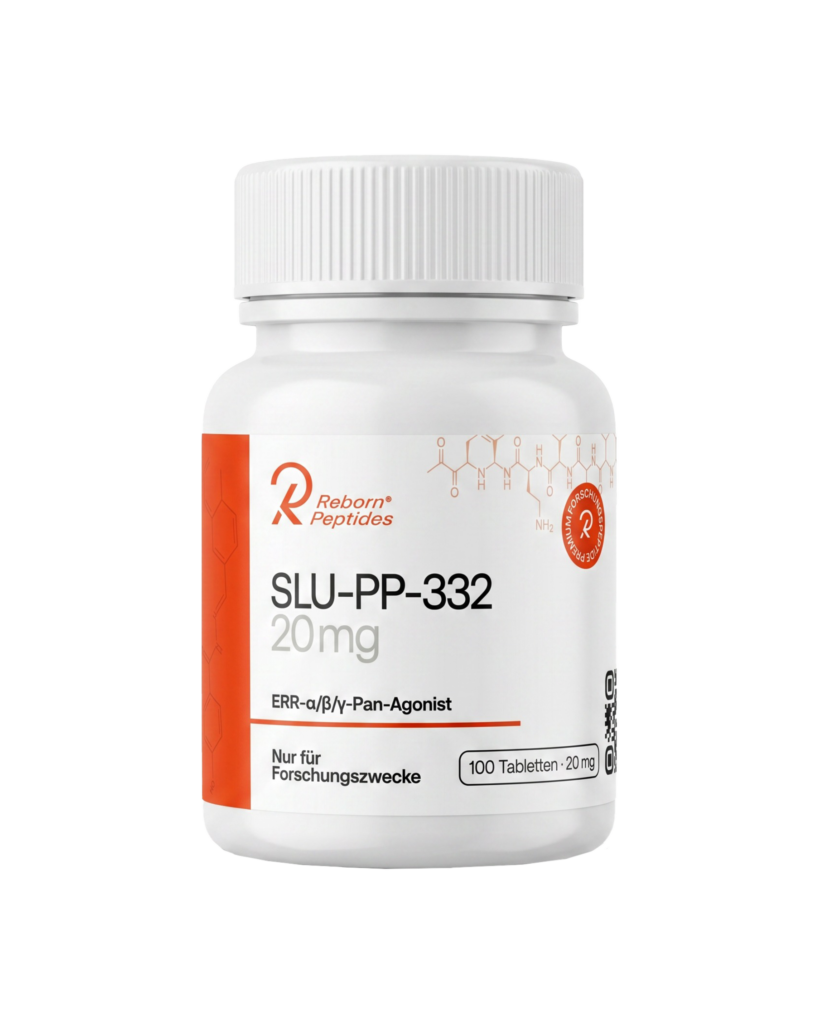
What is SLU-PP-332
SLU-PP-332 is a synthetic acylhydrazone small molecule, not a peptide. It is documented as CAS 303760-60-3, PubChem CID 5338394 and C18H14N2O2, with a molecular weight of 290.32 g/mol, and has been characterised at ERRalpha, ERRbeta and ERRgamma in defined in-vitro assays. It is strictly for laboratory research and is not intended for humans or animals.
Researchers looking to buy slu-pp-332 can select 1 mg, 5 mg, 20 mg or 50 mg strengths, supplied in a tablet format. The exact unit format must be confirmed against the released specification, while chemical identity and any purity result require batch-linked documentation.
Available strengths: 1, 5, 20 and 50 mg — each supplied as 100 tablets per container.
SLU-PP-332 is a synthetic small molecule of the acylhydrazone class rather than a peptide. Its identifiers include CAS 303760-60-3, PubChem CID 5338394 and InChIKey RNZIMBFHRXYRLL-XDHOZWIPSA-N. Reported EC50 values of approximately 98 nM at ERRalpha, 230 nM at ERRbeta and 430 nM at ERRgamma apply only to the assay conditions reported by Billon and colleagues in 2023.
The slu-pp-332 research literature comprises in-vitro systems, preclinical mouse models and one in-vitro pilot in primary human myoblast cultures. Mouse studies examined defined transcriptional, metabolic, cardiac and renal endpoints; the human-origin work remained a cell study and was not an investigation in living people.
The available strengths are 1 mg, 5 mg, 20 mg and 50 mg in a tablet format for laboratory research material. The exact unit format is confirmed only after comparison with the released specification. Chemical identifiers support catalogue reconciliation, whereas supplied-material identity and any purity value must be established from documentation linked to the applicable batch.
There are no in-vivo human studies and no regulatory authorisation. Findings must remain attached to their cell-culture or mouse model and must not be treated as product properties or transferred to humans or other species.

Evidence
In vitro, SLU-PP-332 showed activity at all three ERR subtypes, with approximate EC50 values of 98 nM at ERRalpha, 230 nM at ERRbeta and 430 nM at ERRgamma under the reported assay conditions.
Billon et al. 2023 · PMID 36988910
Mouse studies examined transcriptional and oxidative markers, whole-body metabolic endpoints, cardiac pressure-overload endpoints and ageing-kidney markers; these remain model-specific findings.
PMID 36988910 · PMID 37739806 · PMID 37961903 · PMID 37717940
In-vitro work in donor-derived primary human myoblast cultures assessed oxidative-stress, antioxidant-capacity and senescence-related endpoints; it was not an in-vivo human study.
Bonanni et al. 2025 · PMID 40692696
Database identifiers and literature describe the compound but do not verify supplied material; identity and any purity result must be linked to the applicable batch documentation.
CAS 303760-60-3 · PubChem CID 5338394
Research status
5 selected sources — filterable by study type, each linking straight to the source.
Research Deep Dive
Model-qualified findings in depth — every claim tied to a PubMed-indexed source.
SLU-PP-332 is a synthetic small molecule in the acylhydrazone class. Published pharmacology describes it as a pan-agonist at the three estrogen-related receptor subtypes, ERRα, ERRβ and ERRγ. Chemical identifiers support consistent substance records, but they do not authenticate material from a supplied batch.
| Field | Documented value |
|---|---|
| Compound class | Synthetic small molecule (acylhydrazone) |
| Pharmacological classification | Pan-agonist at ERRα, ERRβ and ERRγ |
| CAS | 303760-60-3 |
| PubChem CID | 5338394 |
| Molecular formula | C18H14N2O2 |
| Molecular weight | 290.32 g/mol |
| InChIKey | RNZIMBFHRXYRLL-XDHOZWIPSA-N |
The CAS number, PubChem CID, formula, mass and InChIKey each serve a documentary purpose. Together they help reconcile a catalogue designation with literature and database records. Confirmation of supplied material additionally requires batch-linked documentation and recorded analytical methods.
Source: Billon et al. 2023 · PMID 36988910 · DOI 10.1021/acschembio.2c00720
Peptides are built from amino acids linked by peptide bonds. SLU-PP-332 does not have that architecture: it is an acylhydrazone small molecule. Its placement in a wider research catalogue does not alter its chemical classification.
ERRα, ERRβ and ERRγ belong to the nuclear-receptor family and are distinct from classical estrogen receptors despite the similarity in their names. These receptors function as transcriptional regulators in experimental systems. Published work places their activity in the context of oxidative-metabolism programmes and the coactivator PGC-1α.
Billon and colleagues reported approximate EC50 values of 98 nM for ERRα, 230 nM for ERRβ and 430 nM for ERRγ in the applicable assay system. These measurements support the pan-ERR classification and a relative ERRα preference within that assay. EC50 values are assay-bound: they must not be treated as universal across cell lines, assay formats or biological models. The same publication used HEK293 cotransfection, C2C12 cells, primary myocytes, C57BL/6J mice and muscle-specific ERRα-knockout mice; each observation remains attached to its model.
Source: Billon et al. 2023 · PMID 36988910 · DOI 10.1021/acschembio.2c00720
Every entry below states the model system it belongs to. All findings involving exposure to SLU-PP-332 come from in-vitro systems or preclinical mouse models: no person received the compound, there are no in-vivo human studies of it, and none of these publications verifies a supplied batch.
HEK293 cotransfection, C2C12 cells, primary myocytes, C57BL/6J mice and muscle-specific ERRα-knockout mice were used to examine an acute ERRα-dependent transcriptional programme, oxidative markers, oxidative muscle-fibre types and markers of mitochondrial function.
Billon et al. · PMID 36988910 · DOI 10.1021/acschembio.2c00720Mice with diet-induced or genetically determined metabolic changes were studied for energy expenditure, fatty-acid oxidation, body composition and insulin sensitivity. These endpoints are findings from preclinical rodent models only.
PMID 37739806 · DOI 10.1124/jpet.123.001733A mouse cardiac transverse-aortic-constriction model with in-vitro components examined cardiac fatty-acid metabolism and mitochondrial-function endpoints. The model does not establish a clinical conclusion.
Xu et al. · PMID 37961903 · DOI 10.1161/CIRCULATIONAHA.123.066542Aged mice and cultured human kidney cells were examined for PGC-1α, Tfam and age-associated inflammatory signals. The model does not establish a clinical conclusion.
Wang et al. · PMID 37717940 · DOI 10.1016/j.ajpath.2023.07.008Primary human myoblast cultures from biopsy material — taken from the inactive subgroup (n=10) of a 20-participant pilot — were treated in vitro and examined for oxidative stress, antioxidant capacity and senescence markers in a SIRT1/PGC-1α/ERRα context. “Human” refers only to the cellular origin, not research in living people.
PMID 40692696 · DOI 10.3389/fphys.2025.1616693The published record described here has firm limits:
Literature identifiers describe the referenced compound, not the contents or quality of delivered material. Incoming review should first reconcile the product designation and chemical identifiers. It should then confirm that the documentation names the applicable batch and records the analytical methods used. Any analytical result, including a purity result, applies only to the batch documented by that record.
Research using human liver S9 fractions and LC-HRMS has described an analytical detection methodology for SLU-PP-332. This is method-development evidence only; it is not biological-outcome evidence and does not authenticate another laboratory's supplied batch.
Sources: Billon et al. 2023 · PMID 36988910 · Avliyakulov et al. 2026, Drug Test Anal · in-vitro metabolism and LC-MS/HRMS method · PMID 41688415 · DOI 10.1002/dta.70035
SLU-PP-332 is listed for controlled laboratory research in four strengths: 1 mg, 5 mg, 20 mg and 50 mg, as a solid format for laboratory research material. This description concerns catalogue range and physical research format only. The exact unit format is confirmed only after reconciliation with the released specification.
Procurement records should keep the declared strength, product designation, batch reference and associated analytical documentation connected. Published studies define research context, while batch records define the material received; neither documentary layer substitutes for the other.
Research use only. For laboratory research only. Not for human or veterinary use. Not intended to diagnose, treat, cure or prevent any disease. Not a medicinal product, food or cosmetic.

FAQ
No. The search term slu-pp-332 peptide is widespread, but the compound is a synthetic acylhydrazone small molecule; its chemical structure is not a peptide architecture. The spelling slu pp 332 peptide refers to the same compound and is just as inaccurate as a class description.
In the reported experimental systems, it denotes agonist activity at ERRalpha, ERRbeta and ERRgamma. The approximate EC50 values of 98 nM, 230 nM and 430 nM respectively are specific to the assay conditions.
The documented strengths are 1 mg, 5 mg, 20 mg and 50 mg in a tablet format for laboratory research material. The exact unit format requires comparison with the released specification.
CAS 303760-60-3, PubChem CID 5338394, molecular formula C18H14N2O2, molecular weight 290.32 g/mol and InChIKey RNZIMBFHRXYRLL-XDHOZWIPSA-N are documented. Batch identity still requires linked analytical records.
The highest level is preclinical mouse research, alongside in-vitro studies. A pilot in primary human myoblast cultures was carried out in vitro on cells taken from donors and does not constitute an in-vivo human study.
Laboratory papers describe mass-spectrometric detection and in-vitro metabolism methods. This is analytical methodology only, not evidence of biological outcomes.
The material is solely for controlled laboratory research, analytical work and method development. It is not a medicinal product and is not intended for humans or animals; batch and specification records must remain traceable.
We accept prepayment by SEPA bank transfer as well as credit card. All payments are processed securely and encrypted.
Discreet shipping from the EU, delivery in 3–5 business days. Neutral packaging with no reference to the contents.