≥ 99 % · HPLC

Oxytocin Acetate
Cognition, Mood & Sleep
38,90 €
38,90 €
incl. shipping & VAT

Certificate of analysis per batch

≥ 99 % purity (HPLC)

Shipping across the EU

Delivery in 3–5 business days
Strength: 10 mg
Quantity:

Fast & secure payment

Delivery: 02.11. – 03.11.

Bacteriostatic water 10 ml
For reconstitution — included free with orders over €70.
Only 70,00 € until your free gift.
 View Certificate of Analysis
Laboratory analysis
Tested by an independent EU laboratory using HPLC against a reference standard. Purity and content of the sample at a glance, full report as PDF – with a verification code to check directly with the lab.
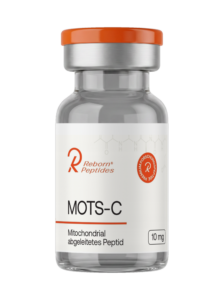
C1F9N1WIWhat is MOTS-C
MOTS-c is a mitochondrial-encoded peptide comprising 16 amino acids. Research examines it in the context of communication between mitochondria and the cell nucleus, metabolic stress responses, and signalling pathways in cell and mouse models.
One mixed publication also measured endogenous MOTS-c in human exercise samples; it did not investigate externally supplied material. The product is offered strictly for laboratory research and is not for use in humans or animals.
Laboratories that buy MOTS-c as reference material can review the product specification and matching batch documentation before procurement.
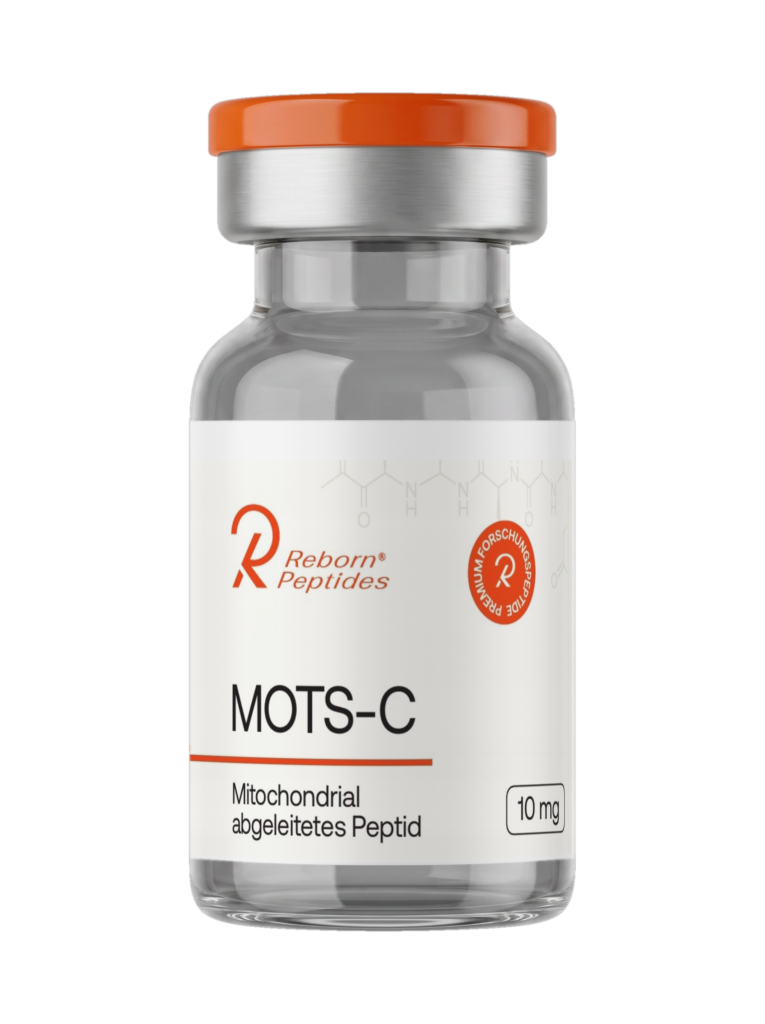
Supplied as 10 mg of lyophilised material per vial, confirmed against the catalogue record.
MOTS-c stands for mitochondrial open reading frame of the 12S rRNA-c and is assigned to an open reading frame within mitochondrial DNA. Its mitochondrial origin has made it relevant to fundamental research on communication between mitochondria and the nucleus. In catalogues, the substance-name apposition appears as mots-c peptide and, with separated lettering, as mots c peptide; both forms require the same identity assessment.
Lee and colleagues examined MOTS-c in mouse and cell models, including AMPK, the folate cycle and purine biosynthesis. Kim and colleagues described AMPK-dependent nuclear translocation under metabolic stress in cellular and molecular models, alongside changes in nuclear gene-expression programmes.
Yang and colleagues studied C2C12 myotubes and mice under diet- and exercise-related experimental conditions, measuring PGC-1alpha expression, AMPK/ACC phosphorylation, GLUT4 and markers of glucose metabolism. These findings remain bound to the stated cell and mouse models.
Reynolds and colleagues combined human exercise samples with mouse models. The human component measured naturally occurring MOTS-c levels after exercise and provides no evidence about externally supplied material.
Literature findings do not establish the identity, content or purity of a commercial batch. Those characteristics require the matching product specification, batch code and COA. Any HPLC purity result applies only to the tested batch and documented method. MOTS-c is strictly for laboratory research and is not for use in humans or animals.

Evidence
MOTS-c was examined in mouse and cell models in relation to skeletal-muscle metabolism, AMPK, the folate cycle and purine biosynthesis.
Lee et al. 2015 · PMID 25738459
In cellular and molecular models under metabolic stress, MOTS-c showed AMPK-dependent nuclear translocation associated with nuclear gene-expression programmes.
Kim et al. 2018 · PMID 29983246
A mixed study measured increased endogenous MOTS-c after exercise in human samples; it did not investigate externally supplied material, and the mouse findings remain separate.
Reynolds et al. 2021 · PMID 33473109
C2C12 myotube and mouse models were used to examine PGC-1alpha, AMPK/ACC phosphorylation, GLUT4 and glucose-metabolism markers under defined experimental conditions.
Yang et al. 2021 · PMID 33722744
Literature does not establish the identity, content or purity of a commercial batch; any HPLC purity result applies only to the tested batch and documented method.
Reborn batch documentation · COA with HPLC
Research status
4 selected sources — filterable by study type, each linking straight to the source.
Research Deep Dive
Model-qualified findings in depth — every claim tied to a PubMed-indexed source.
MOTS-c is a peptide comprising 16 amino acids. Its name expands to “mitochondrial open reading frame of the 12S rRNA-c” and records its genetic origin: the underlying open reading frame is assigned to mitochondrial DNA rather than nuclear DNA. Foundational work described this identity in preclinical mouse and cell models. The genetic description distinguishes MOTS-c from a synthetic sequence that is merely directed towards mitochondria.
The literature places MOTS-c among mitochondrial-derived peptides. That classification describes molecular origin and a field of signalling research; it does not establish the identity, content or analytical characteristics of supplied material. Product designation, batch code, test method and result must be reconciled before a batch is assigned to an experiment. Sequence, formula, molecular mass and CAS identifier below describe the unmodified free peptide as a reference identity; the salt or solvate form and the measured mass of any supplied batch remain a question for that batch's COA.
| Field | Reference specification |
|---|---|
| Name | MOTS-c |
| Code | Mitochondrial open reading frame of the 12S rRNA-c |
| Class | Mitochondrial-derived peptide |
| Length | 16 amino acids |
| Genetic origin | 51-bp open reading frame within the mitochondrial MT-RNR1 (12S rRNA) region |
| Target profile | Mitonuclear communication and metabolic-signalling research in specified cell and mouse models |
| Sequence | MRWQEMGYIFYPRKLR (unmodified free peptide) |
| Molecular formula | C101H152N28O22S2 (unmodified free peptide; salt or solvate form per COA) |
| Molecular mass | 2174.6 g/mol (average, unmodified free peptide; batch form per COA) |
| CAS identifier | 1627580-64-6 (human MOTS-c reference identity; verify batch form by COA) |
Names and literature classifications do not authenticate a batch. HPLC can describe a chromatographic profile or method-specific purity result, but any such result applies only to the tested batch and reported method. Molecular identity and chromatographic purity remain separate analytical questions.
Source record: Lee et al. 2015 · PMID 25738459
Mitonuclear signalling is a research term for communication between mitochondria and the cell nucleus. Mitochondria contain their own genetic material, while many components involved in their function are encoded by nuclear genes. Research therefore asks how signals associated with mitochondrial state relate to nuclear gene programmes. “Mitokine” is another category term used for signalling molecules of mitochondrial origin; it is not a quality designation.
Kim et al. studied cellular and molecular systems under metabolic stress and reported AMPK-dependent relocation of MOTS-c to the nucleus.
In those cellular systems, nuclear gene expression and stress-responsive transcriptional relationships were measured as model-bound variables.
Translocation, AMPK and gene-expression measurements are mechanistic markers, not clinical endpoints or batch specifications.
Kim and colleagues linked mitochondrial encoding with signalling outside the organelle in cellular and molecular models. Under the tested metabolic-stress conditions, the authors described AMPK-dependent nuclear translocation and changes involving nuclear gene expression, antioxidant-response-element signalling and NRF2-related interactions. Each observation remains tied to the cell system, timing, stress condition and analytical method used.
Lee and colleagues investigated AMPK-related processes, the folate cycle and purine biosynthesis in mouse and cell models. Yang and colleagues measured PGC-1α expression, AMPK and ACC phosphorylation, GLUT4 and glucose-metabolism markers in C2C12 myotubes and mice. These are measurements within named preclinical models. Multiple aligned markers do not remove differences between cell systems, mouse species and human samples.
Mechanism sources: Kim et al. 2018 · PMID 29983246 · Lee et al. 2015 · PMID 25738459 · Yang et al. 2021 · PMID 33722744
This section describes findings in controlled research and makes no statement about use. The four records must be read by model, species, method and measured endpoint; they do not form a single body of human intervention evidence.
In cellular and molecular models under metabolic stress, the study reported AMPK-dependent nuclear translocation and nuclear gene-expression measurements. These cellular markers are not clinical endpoints.
PMID 29983246Mouse and cell models examined AMPK-related processes, the folate cycle, purine biosynthesis and skeletal-muscle metabolic measurements. The findings remain preclinical and species-specific.
PMID 25738459C2C12 myotubes and mouse models were used to measure PGC-1α expression, AMPK and ACC phosphorylation, GLUT4 and glucose-metabolism markers under diet- and exercise-related experimental conditions. They are not clinical endpoints.
PMID 33722744The badge records the highest model tier in which MOTS-c was actually administered, and that tier is the mouse arm. The publication's human component was observational: it measured endogenous MOTS-c levels in skeletal muscle and circulation after cycle ergometry, examining the body's own peptide rather than externally supplied material. The parallel mouse findings must not be transferred to humans.
PMID 33473109Reynolds requires a strict three-part boundary. First, its human component measured endogenous MOTS-c after physical activity. Second, that means the body's own peptide was observed; externally supplied material was not investigated in those human samples. Third, the publication's parallel mouse findings remain animal evidence and are not transferred to humans. Combining the human sampling and mouse experiments into one human claim would misstate the mixed design.
Study sources: Kim et al. 2018 · PMID 29983246 · Lee et al. 2015 · PMID 25738459 · Yang et al. 2021 · PMID 33722744 · Reynolds et al. 2021 · PMID 33473109
“MOTS-c”, “mitochondrial open reading frame of the 12S rRNA-c” and “mitochondrial-derived peptide” describe related aspects of the same literature record: abbreviated name, encoded origin and research class. “Mitochondrially encoded” specifies where the open reading frame lies. “Mitonuclear” specifies a communication question between mitochondria and nucleus. “Mitokine” is a broader signalling category. These terms should not be collapsed into claims about a supplied batch.
The evidence map has three distinct model layers. Cellular systems support mechanistic observations such as nuclear translocation and gene-expression measurements. Mouse models support preclinical, species-bound findings. The human component of one mixed publication is limited to endogenous-level measurements around physical activity and is not a substance-intervention study. AMPK, PGC-1α, GLUT4, ACC phosphorylation and nuclear gene expression are measured markers, not clinical endpoints.
Published work also does not establish the identity, amount, physical form or purity of supplied material. Those require matching product and batch records. If HPLC reports a numerical purity result, it applies only to the tested batch and within the stated method. It cannot be generalised to MOTS-c as a class, and HPLC alone does not settle every molecular-identity question.
Evidence-map sources: Kim et al. 2018 · PMID 29983246 · Lee et al. 2015 · PMID 25738459 · Yang et al. 2021 · PMID 33722744 · Reynolds et al. 2021 · PMID 33473109
MOTS-c is supplied to laboratories in the EU as research material. Incoming documentation should connect the product designation and batch code with the applicable analytical method, test date and result. Any discrepancy between label, specification and COA should be resolved before the material is described as a matter of fact or assigned to a controlled study.
The literature frames molecular questions and model-specific measurements; it does not certify supplied material. Batch documentation serves a separate purpose. Any purity statement is method-specific and applies only to the tested batch. No amount, physical form, storage condition, stability period or blanket analytical property is asserted in this record.
Research use only. For laboratory research only. Not for human or veterinary use. Not intended to diagnose, treat, cure or prevent any disease. Not a medicinal product, food or cosmetic.

FAQ
Why MOTS-C from Reborn?
Researchers looking to buy MOTS-C require a documented research peptide with a traceable literature basis. RP-1018 is listed as a 10 mg research material. Its scientific context includes mitochondrial-derived peptides, AMPK signalling, skeletal-muscle metabolism, glucose/insulin signalling, exercise-related research and ageing/metabolic models.
MOTS-C is supplied strictly for laboratory research. Batch analytical documentation and the lot number provide the basis for assessing the respective batch. This page describes areas of research, without claims of effects in humans.
MOTS-c is a mitochondrially encoded peptide comprising 16 amino acids. Its name derives from mitochondrial open reading frame of the 12S rRNA-c, referring to its genetic origin within mitochondrial DNA.
Mitochondrially encoded means that the underlying open reading frame lies in mitochondrial rather than nuclear DNA. Mitokines are discussed as signalling molecules of mitochondrial origin that convey information about the organelle's state to other parts of the cell; the term names a research category, not a purpose of use.
Preclinical studies examined AMPK-related processes, the folate cycle and purine biosynthesis in mouse and cell models, and measured PGC-1alpha, AMPK/ACC phosphorylation, GLUT4 and glucose-metabolism markers in C2C12 myotubes and mice. These results do not establish transferability to humans.
In cellular and molecular models under metabolic stress, researchers observed AMPK-dependent movement of MOTS-c into the nucleus and examined associated changes in nuclear gene expression. This mechanistic finding remains specific to the studied models.
Researchers measured an increase in endogenous MOTS-c in human skeletal muscle and circulation after exercise. The study did not investigate externally supplied material, and its parallel mouse findings cannot be transferred to humans.
Different model types within one publication must remain separate. In the cited mixed study, the human component measured endogenous MOTS-c, while broader experimental investigations were conducted in mice.
Cell, myotube, mouse and human exercise-sample findings do not form a unified body of human-intervention evidence. Markers such as AMPK, PGC-1alpha, GLUT4 and nuclear gene expression are model-specific measurements, not clinical endpoints.
Quality statements require documentation linked to the specific batch. HPLC can provide a chromatographic profile and method-specific purity result for the tested batch, while the batch identifier, analytical method and result must be read together.
We accept prepayment by SEPA bank transfer as well as credit card. All payments are processed securely and encrypted.
Discreet shipping from the EU, delivery in 3–5 business days. Neutral packaging with no reference to the contents.