≥ 99 % · HPLC
HGH Fragment 176-191
Metabolism, Weight & Muscle
38,90 €
149,90 €
incl. shipping & VAT

Certificate of analysis per batch

≥ 99 % purity (HPLC)

Shipping across the EU

Delivery in 3–5 business days
Strength: 80 mg
Quantity:

Fast & secure payment
Bacteriostatic water 10 ml
For reconstitution — included free with orders over €70.
Only 70,00 € until your free gift.

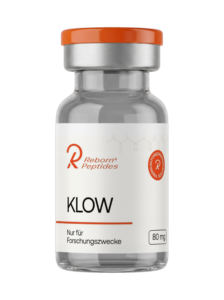
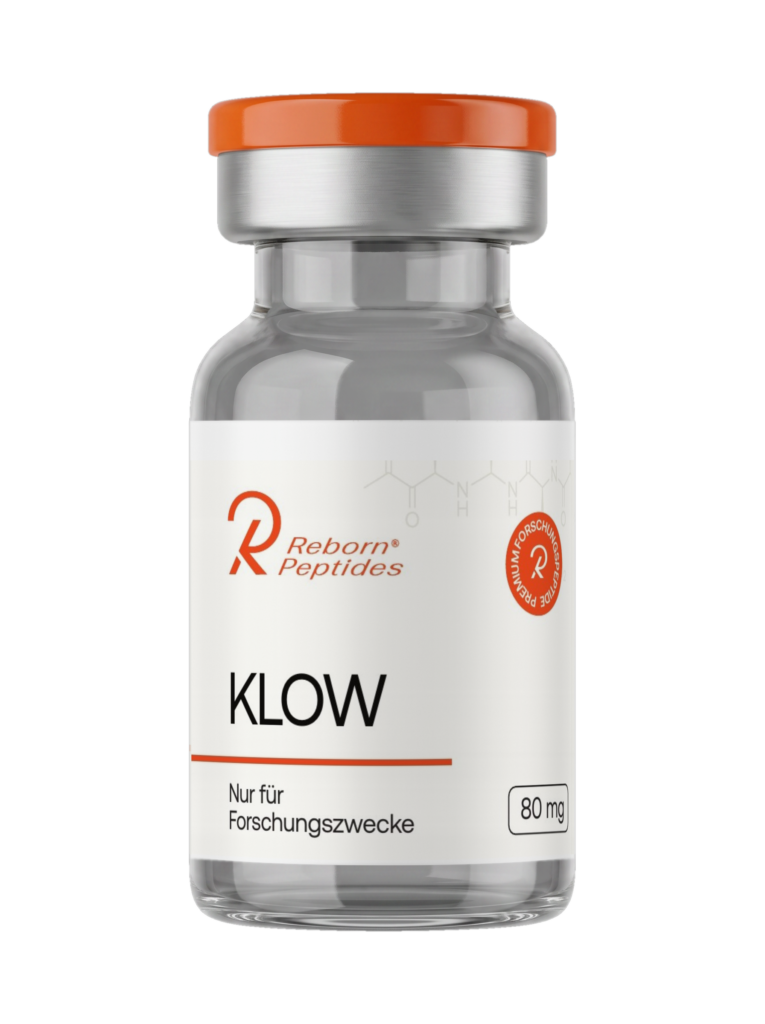
What is KLOW Blend
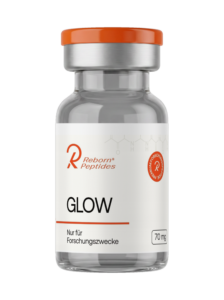
KLOW peptide is a four-component research material containing GHK-Cu, TB-500, BPC-157 and KPV, catalogued at 80 mg total. It is supplied as a lyophilised laboratory material. KLOW differs from GLOW: GLOW contains the first three components without KPV and is catalogued at 70 mg total.
The product is supplied strictly for laboratory research and is not for human or veterinary use. Not a medicinal product, food or cosmetic. Component publications do not establish properties of the combined material.
Laboratories assessing a KLOW blend peptide should reconcile the four-component declaration, amounts, batch code and matching COA. Any HPLC result applies only to the tested batch and documented method.
The KLOW peptide is defined as a four-component composition of GHK-Cu, TB-500, BPC-157 and KPV, catalogued at 80 mg total. A per-component split of 50 mg GHK-Cu, 10 mg TB-500, 10 mg BPC-157 and 10 mg KPV is reconstructed from the documented GLOW allocation and the separate KPV article; it is not itself stated in the product record. It should therefore be reconciled against the released label, specification and applicable batch document. The wording KLOW 80mg describes Reborn's catalogue configuration, not a universal property of the KLOW designation.
KLOW and GLOW are related but different compositions. GLOW contains GHK-Cu, TB-500 and BPC-157 without KPV and is catalogued at 70 mg total; KLOW adds the Lys-Pro-Val tripeptide KPV and is catalogued at 80 mg total. A GLOW analytical record cannot substantiate KLOW, and literature concerning KPV alone cannot establish a combined effect.
The KLOW blend is described at combination level, not as a monograph for any single component. GHK-Cu is a copper(II) complex of Gly-His-Lys, BPC-157 is a synthetic 15-amino-acid peptide, and KPV is the Lys-Pro-Val tripeptide. TB-500 nomenclature remains ambiguous: analytical literature uses the name for Ac-LKKTETQ, while wider supplier usage may refer to full-length, 43-amino-acid thymosin beta-4. The exact molecular form should be reconciled through the product specification and batch analytics.
Component findings remain bound to their molecule, model and endpoint. They do not establish combined KLOW behaviour, a common mechanism or additive effects, and they do not verify a commercial batch. Batch documentation should link the KLOW designation and batch code to the test date, analytical method and reported finding. HPLC can document a chromatographic profile and purity value only for the tested batch and within the limits of the documented method; identity records should address all four declared components.

Evidence
KLOW comprises GHK-Cu, TB-500, BPC-157 and KPV and is catalogued at 80 mg total; the stated component allocation should be reconciled against released product and batch records.
Product 100 · SKU RP-1015 · released label, specification and matching batch COA
GLOW contains GHK-Cu, TB-500 and BPC-157 without KPV and is catalogued at 70 mg total; GLOW records cannot substantiate KLOW.
Declared KLOW and GLOW compositions
In vitro fibroblast studies measured collagen-synthesis and MMP-2-expression endpoints.
Maquart et al. 1988 · PMID 3169264 · Siméon et al. 2000 · PMID 11045606
Ac-LKKTETQ versus full-length thymosin beta-4 should be resolved through the product specification and matching batch analytics.
Esposito et al. 2012 · PMID 22962027 · Ho et al. 2012 · PMID 23084823 · batch-specific identity records
CAM, endothelial-cell, preclinical rat and ex vivo rat-aorta systems measured VEGFR2-, Akt-, eNOS- and NO-related endpoints.
Hsieh et al. 2017 · PMID 27847966 · Hsieh et al. 2020 · PMID 33051481
KPV is included only as the Lys-Pro-Val component; the source provides no verified KPV publication supporting a component outcome.
Declared KLOW composition
Component publications do not establish properties, behaviour, a common mechanism or additive effects of the four-component composition.
Component-level literature only
HPLC findings apply only to the tested batch and documented method; identity records should address all four declared components and reconcile the stated amounts.
Matching batch COA · HPLC and identity records
Research status
6 selected sources — filterable by study type, each linking straight to the source.
Research Deep Dive
Model-qualified findings in depth — every claim tied to a PubMed-indexed source.
KLOW peptide is the catalogue name for a four-component research blend. The 80 mg total declared peptide per vial is the amount under which the material is catalogued. The per-component allocation — GHK-Cu 50 mg, TB-500 10 mg, BPC-157 10 mg and KPV 10 mg — is not itself stated in the product record; it is reconstructed from the documented GLOW allocation plus the separate KPV article and must be reconciled against the label and the applicable batch document.
The declaration describes a reference composition, not a mixture-level experimental finding. A single CAS identifier, formula or molecular mass would incorrectly collapse four separate molecular identities into one.
| Field | KLOW blend reference specification |
|---|---|
| Catalogue name | KLOW peptide blend |
| Components and amounts (split reconstructed, to be reconciled) | GHK-Cu 50 mg · TB-500 10 mg · BPC-157 10 mg · KPV 10 mg |
| Total declared peptide | 80 mg per vial |
| SKU | RP-1015 |
| Form | lyophilised laboratory material |
| WooCommerce product | 100 |
| Class | four-component research blend |
| CAS / formula / molecular mass | not applicable to the blend as a single identity; component identity requires batch-document reconciliation |
TB-500 also requires an explicit molecular assignment. Analytical literature uses this name for the acetylated fragment Ac-LKKTETQ, while wider catalogue usage may refer to full-length, 43-amino-acid thymosin beta-4. The applicable specification and batch analytics should identify which molecular form is present.
Analytical context: Esposito et al. 2012 · PMID 22962027 · Ho et al. 2012 · PMID 23084823
Each card identifies one declared component and keeps its literature boundary separate from the KLOW blend. The cited observations belong to the stated molecule and model; they do not characterise the four-component material.
GHK-Cu is the copper(II) complex of Gly-His-Lys and supplies the copper-bound tripeptide component. Published work measured collagen-synthesis and MMP-2-expression endpoints in vitro in fibroblast cultures; these model-specific observations do not establish KLOW blend behaviour. Full research deep dive →
TB-500 names the Tβ4-related component, but the precise molecular form remains a batch-specification question. Analytical publications characterised Ac-LKKTETQ, whereas full-length thymosin beta-4 is a different molecular object. Full research deep dive →
BPC-157 is the declared synthetic 15-amino-acid component with sequence GEPPPGKPADDAGLV. Component publications measured VEGFR2-, Akt-, eNOS- and NO-related endpoints across CAM, cell, ex vivo and preclinical rat models, without testing KLOW as a combination. Full research deep dive →
KPV is Lys-Pro-Val, the C-terminal tripeptide fragment of alpha-melanocyte-stimulating hormone, and is the additional component that distinguishes KLOW from GLOW. Its compound profile belongs to the component page; no mixture-level property is inferred from its inclusion. Full research deep dive →
Component model sources: Maquart et al. 1988 · PMID 3169264 · Siméon et al. 2000 · PMID 11045606 · Hsieh et al. 2017 · PMID 27847966 · Hsieh et al. 2020 · PMID 33051481
KLOW and GLOW are related catalogue compositions, but they are not interchangeable. KLOW carries four components — GHK-Cu, TB-500, BPC-157 and KPV — and is catalogued at an 80 mg total. GLOW declares the first three components without KPV and is catalogued at a 70 mg total.
The additional KPV changes the composition and the documentation required to substantiate it. A GLOW certificate cannot substantiate KLOW, and a certificate concerning one component cannot substantiate the complete four-component material.
The source inventory contains literature on isolated components in different molecular forms, cell systems, ex vivo preparations and animal models. It contains no publication that establishes a combined KLOW effect, additive behaviour or synergy. Shared endpoint terminology across component publications does not convert separate experiments into combination evidence.
The same boundary applies to TB-500 nomenclature. Research on Ac-LKKTETQ and research on full-length thymosin beta-4 concern different molecular objects; neither assignment can be transferred to the supplied component without matching specification and batch analytics.
Evidence-boundary examples: Philp et al. 2003 · PMID 12581423 · Safer et al. 1991 · PMID 1999398
KLOW is specified as lyophilised laboratory material. No temperature, stability period, shelf-life or light condition is asserted here because the source record does not verify one. Binding conditions should come from the released specification, label and applicable batch documentation.
Each released KLOW batch should have an attributable Certificate of Analysis linked by product designation and batch code. The record should state the test date, analytical method and reported finding, and should reconcile the four named components, their declared amounts, the 80 mg total and the material form.
HPLC may report a chromatographic profile or method-specific purity result for the tested batch. Such a result remains limited to that batch and method; it does not by itself establish every component identity or support a blanket purity claim. Mass-sensitive analysis is particularly relevant where the TB-500 assignment must distinguish Ac-LKKTETQ from full-length thymosin beta-4.
A GLOW COA is not a KLOW COA, and a component COA is not a KLOW COA. Documents without the matching KLOW designation and batch code cannot substantiate the supplied four-component material.
Molecular-form boundary: Sanders et al. 1992 · PMID 1584803
KLOW peptide is supplied to laboratories in the EU as research material. Before assignment to a controlled study, laboratory records should reconcile the catalogue designation, SKU RP-1015, batch code, four-component declaration, 80 mg total and applicable COA.
Published component literature provides model-specific context only and does not certify supplied material or establish a result for the KLOW blend. Any discrepancy between the label, specification and batch documentation should be resolved before composition or analytical status is recorded as a batch fact.
For laboratory research only. Not for human or veterinary use.
FAQ
KLOW is a lyophilised four-component laboratory material containing GHK-Cu, TB-500, BPC-157 and KPV, catalogued at 80 mg total. The name identifies a composition, not a combined research outcome.
KLOW contains GHK-Cu, TB-500, BPC-157 and KPV and is catalogued at 80 mg total. GLOW contains GHK-Cu, TB-500 and BPC-157 without KPV and is catalogued at 70 mg total. Their analytical records are not interchangeable.
A split of 50 mg GHK-Cu, 10 mg TB-500, 10 mg BPC-157 and 10 mg KPV is reconstructed from the documented GLOW allocation and the separate KPV article and is not itself stated in the product record. Because the split is reconstructed, batch documentation should show agreement among the released label, specification, individual amounts and 80 mg total.
The name alone cannot decide this. Analytical literature uses TB-500 for Ac-LKKTETQ, while wider supplier usage may refer to full-length, 43-amino-acid thymosin beta-4. The exact assignment should be established by the product specification and matching batch analytics.
It provides model-specific context for separately studied components. No cited source characterises the combined four-component KLOW material, establishes mixture behaviour or makes findings transferable between components.
Selected publications used in vitro fibroblast cultures to measure collagen-synthesis and MMP-2-expression endpoints. These findings remain specific to GHK-Cu and the stated systems.
Selected analytical publications examined the acetylated fragment in an in vitro analytical model and an animal analytical model. They do not resolve the identity of the supplied batch without matching product and batch records.
Selected studies examined VEGFR2-, Akt-, eNOS- and NO-related measurements in CAM, endothelial-cell, preclinical rat and ex vivo rat-aorta systems. These component findings do not establish a KLOW mixture property.
It should link the KLOW designation and batch code to the test date, analytical method and reported finding, and show how component identity and the declared amounts were reconciled. An HPLC result is specific to the tested batch and method; no general purity percentage is claimed.
KLOW is supplied strictly for laboratory research and is not for human or veterinary use. Not a medicinal product, food or cosmetic.
We accept prepayment by SEPA bank transfer as well as credit card. All payments are processed securely and encrypted.
Discreet shipping from the EU, delivery in 3–5 business days. Neutral packaging with no reference to the contents.