How to Reconstitute Peptides in a Laboratory Setting
Reconstitution is the return of a lyophilised solid to a liquid state under a defined laboratory method. The result depends on the identity and supplied form of the material, the solvent class, handling conditions and subsequent storage. These variables belong in the laboratory’s controlled method and records. All materials discussed here are for laboratory research use only.
The question of how to reconstitute peptides concerns material behaviour and the controls surrounding peptide reconstitution. This page explains those matters and deliberately does not provide a preparation, dilution or use protocol. Research materials require a method selected, assessed and validated by the responsible laboratory; a general web page cannot replace that work.
What peptide reconstitution means
Lyophilisation removes water from frozen material under reduced pressure, leaving a dry solid. Depending on the formulation and process, that solid may appear as a coherent cake, a pellet or a less uniform residue. Its appearance alone does not establish identity, content or batch quality. Those questions remain connected to the label, certificate of analysis and relevant analytical records.
Material is often supplied in lyophilised form because removing bulk water can improve stability during storage and transport. It can reduce some degradation pathways that proceed more readily in solution. This is a general rationale rather than a universal stability claim: the behaviour of a particular material still depends on its composition, packaging and documented storage conditions.
Reconstitution introduces a suitable liquid so that the dry material can disperse and, where compatible, dissolve. A solution is molecularly dispersed and visually uniform at the scale available to routine observation. A suspension contains undissolved particles dispersed through the liquid. Clear appearance can be useful observational evidence, but it does not prove chemical integrity, sterility or the absence of sub-visible particles. Conversely, visible material does not identify its cause without further investigation. In this general sense, reconstituting peptides describes a material transition governed by laboratory controls, not a universal procedure.
When reconstituting lyophilised material, the relevant question is therefore not simply whether liquid has been added. The laboratory must know whether the chosen solvent and conditions are compatible with the material and with the planned analytical method. Solubility, chemical stability and the method’s acceptance criteria are distinct considerations. Accordingly, how to reconstitute peptides remains a material-specific question whose binding values come from the released product and batch documentation for the material concerned.
The lyophilised material overview covers supplied solid forms and containers; this page addresses only the transition into solution and the controls that follow it. That boundary holds across the catalogue: every listed presentation — blended material such as the GLOW stack and the KLOW blend, or single-substance material such as tesamorelin and AOD-9604 — is supplied without a preparation protocol, and compatibility assessment remains with the receiving laboratory in every case.
Solvent selection in laboratory work
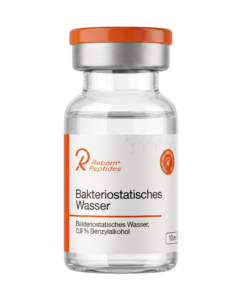
Solvent selection is material- and method-specific. Preservation status does not establish compatibility, chemical stability or suitability for an assay. The preserved laboratory water guide covers water quality and preservation; those properties remain separate from the compatibility assessment that governs reconstitution. The phrase bacteriostatic water for peptide reconstitution names one preserved solvent class in that context, whose identity and documentation are set out on the bacteriostatic water product page; whether it suits a given material still follows from material-specific information and the documented laboratory method, not from preservation status alone.
Water-based solvents are not automatically suitable for every lyophilised substance. Molecular properties can make solubility sensitive to pH, ionic composition or the presence of co-solvents. A change that improves apparent solubility may still affect chemical stability or interfere with the intended assay. The appropriate solvent class must therefore come from material-specific information and a documented laboratory method, not from a generic rule. This evidence requirement defines any responsible account of how to reconstitute peptides.
Handling that changes the outcome
Reconstitution creates new opportunities for contamination and physical stress. Clean working practices, controlled access to containers and suitable environmental controls reduce avoidable variation. Sterile technique is a system of personnel practice, workspace control, qualified materials and documented procedures; it is not established by one component or by a preserved solvent alone.
In suitable formulations, the preservative inhibits microbial growth; it should not be described as killing every microorganism or correcting contamination that has already occurred.
Mechanical stress is one of the variables a validated method has to control. Agitation, the way solvent and solid meet, and the resulting air–liquid interfacial area are method parameters rather than matters of preference: foaming enlarges that interfacial area, and repeated contact with interfaces can be relevant to surface-associated unfolding or aggregation for susceptible materials. Which settings apply follows from material-specific information and the laboratory’s own validated procedure, not from a general web page.
Temperature is a further method-defined variable. Differences between material, solvent and environment may affect dissolution behaviour and can lead to condensation on cold containers. Where and how temperature is controlled is fixed in the applicable material record and the laboratory’s procedure. That a variable is documented does not establish that every material responds to it identically; formulation, sequence and vessel surface can all influence what is observed.
Visible residue, unexpected cloudiness, colour change or particles are observations that belong in the record and, where the criteria require it, in the deviation process. Follow-up is governed by the validated procedure and the acceptance criteria, not by an improvised change of solvent or handling. The record should preserve what was seen, when it appeared and which material, solvent and container were involved. An unexplained visual change is a deviation to assess, not proof of a particular chemical or microbiological cause.
Stability after dissolution
Once dissolved, material is generally more exposed to hydrolysis, oxidation, aggregation and surface interactions than it was in the dry state. The relative importance of each pathway varies by molecule and formulation. This is why the storage statement for a lyophilised product cannot simply be carried over to its dissolved state.
Temperature control can slow some degradation processes, but refrigeration does not stop every reaction and does not reverse contamination. Light exposure may matter for light-sensitive components. Repeated movement between frozen and thawed states can add physical stress, change local concentration during ice formation and promote aggregation in susceptible materials. Adsorption to container walls can also reduce material available in solution, particularly where surface area, concentration and container composition make that interaction significant.
There is no defensible universal shelf-life for all reconstituted research peptides. A holding period must be supported for the specific material, solvent, container, temperature and acceptance criteria. Without relevant stability data, a precise duration would be an unsupported claim. The storage and handling guide covers monitored storage and inventory controls; the lyophilised material overview explains the supplied form before dissolution.
Laboratories should also distinguish chemical stability from microbiological control and physical appearance. A solution can remain clear while chemical change occurs, and a preservative does not demonstrate chemical stability. Each property requires evidence appropriate to the question being asked.
What to record
A reconstitution record should preserve traceability from the dry material to the resulting laboratory preparation. Core fields include the material name, batch or lot identifier, solvent class, solvent batch or lot, date of preparation, responsible operator and storage location. Container identity and relevant environmental or equipment references may also belong in the record where the laboratory method requires them.
Observations are part of the evidence. The initial appearance of the lyophilised material, the appearance after solvent contact, visible residue, cloudiness, colour and any deviation should be recorded in consistent language. Records should state what was observed rather than assigning an untested cause. Any disposition decision should remain connected to the laboratory’s deviation process and acceptance criteria.
The material batch identifier should match the applicable COA, while the solvent retains its own independent identity and lot trail. One document does not establish the quality attributes of the other. The guide to understanding the COA explains how identifiers, tests and results remain tied to a specific batch. The wider knowledge hub connects those records with material form, analytical scope and responsible evidence review.
Good documentation also preserves changes after preparation. Transfers, storage changes, access events and observations made during the defined holding period should remain attributable and chronological. This allows the laboratory to investigate an unexpected result without reconstructing conditions from memory. Documentation supplies the controlling context for the question of how to reconstitute peptides in a laboratory quality system.
Research-use statement
All materials referenced on this page are for laboratory research use only and are not for human or veterinary use. This overview does not replace material-specific compatibility assessment, method validation, laboratory risk assessment or the controls defined by the responsible organisation.