Bacteriostatic Water vs Sterile Water in Laboratory Use
Preserved laboratory water contains an added preservative; unpreserved laboratory water does not. That compositional distinction is the basis for the different terminology, label fields and documentation checks described on this page. All materials discussed on this page are exclusively for laboratory research.
This page describes water grades — bacteriostatic water vs sterile water — and the records used to identify them. It deliberately makes no statement about practical use, quantities or processing routes because the materials described are reserved for research purposes. Method selection and suitability assessment remain the responsibility of the laboratory.
What “bacteriostatic” actually describes
“Bacteriostatic” describes inhibition of microorganism growth, while “bactericidal” describes a killing effect. The distinction rests on two separate measurements: the minimum inhibitory concentration is the lowest concentration at which growth is not observed under defined conditions, whereas the minimum bactericidal concentration is the lowest concentration that reduces the viable count by 99.9 per cent, that is by three log10 steps (Working Party on Antibiotic Susceptibility Testing of the European Society of Clinical Microbiology and Infectious Diseases, Methods for the determination of susceptibility of bacteria to antimicrobial agents. Terminology, Clinical Microbiology and Infection 4(5):291–296 (1998), doi:10.1111/j.1469-0691.1998.tb00061.x). Where a substance only inhibits, that second criterion is not met and the two concentrations diverge by many multiples instead of coinciding (Levison ME, Levison JH, Pharmacokinetics and Pharmacodynamics of Antibacterial Agents, Infectious Disease Clinics of North America 23(4):791–815 (2009), doi:10.1016/j.idc.2009.06.008). The terms are therefore not interchangeable: an inhibitory characteristic must not be rewritten as a claim that microorganisms are eliminated.
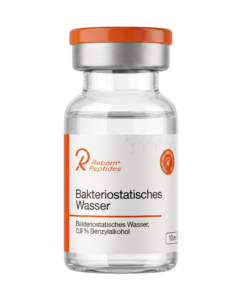
In the material described by Reborn, benzyl alcohol is the added preservative. The bacteriostatic description is associated with that addition rather than being an inherent property of water itself. A benzyl alcohol preserved water must still be identified through its declared composition and applicable records; the category name alone does not establish the specification of a particular batch.
The preservative statement does not prove absence of contamination, chemical stability or compatibility with another research material or analytical method. Those questions require separate evidence.
Preserved and unpreserved water grades side by side
Read in either direction — bacteriostatic water vs sterile water, or sterile water vs bacteriostatic water — the comparison concerns category language and documentary identity, not a ranking of the two. “Sterile water” appears only as an unpreserved product category, not as a quality promise for Reborn material.
For bacteriostatic water vs sterile water, compare the added substance. A preservative is declared for the preserved category. Benzyl alcohol is the preservative in this material. No preservative is declared for the unpreserved category. The preserved label carries the product name. It also carries the preservative and documented composition. The unpreserved label carries the product name. It also carries the applicable water-grade designation.
In bacteriostatic water vs sterile water, compare the designations. The preserved designation records an additive characteristic. The unpreserved designation records the water category. Neither states suitability or equivalence. Neither states chemical stability or batch quality. Evidence for both categories begins with the label. It includes the released supplier data sheet. It also includes the batch-linked document.
For bacteriostatic water vs sterile water, three records matter. The label provides the designation. The released data sheet provides the description. The batch-linked document connects it to the material. The records show what the designation states. They also show what the designation does not state.
These categories are not substitution instructions. The separation is pharmacopoeial rather than editorial: the compendium carries the preserved and the unpreserved grade as two separately titled monographs, one defined as a sterilised, suitably packaged water grade “containing one or more suitable antimicrobial agents”, the other defined as one that “contains no antimicrobial agent or other added substance” (United States Pharmacopeia, USP–NF monographs (2017 and 2020), doi:10.31003/USPNF_M88830_03_01 and doi:10.31003/USPNF_M88870_05_01). Those monograph titles are pharmacopoeial category designations; Reborn supplies no medicinal preparation under either. The responsible laboratory selects a material through its controlled method plan and released documentation. Similar wording does not establish interchangeability.
Grade names are not the same as product characteristics
WFI is the name of a water grade, not a statement of purpose. Its written-out form remains a grade designation in this context, and Reborn does not supply a medicinal preparation under that designation — the term appears here only to keep the terminology apart. It is not synonymous with “bacteriostatic,” because the latter describes a characteristic associated with an added preservative.
“Sterile water” is likewise used here only as a category designation. “Bacteriostatic” identifies neither the complete composition nor the underlying water grade. A label can therefore contain terms that answer different questions: one may identify a water grade, another the presence or function of an additive, and another the particular product.
Similar labels do not prove identical material. The product designation, declared composition, stated concentration, batch or lot identifier and document reference must agree. If a field is inconsistent, identity should remain unresolved rather than inferred from the category name.
Benzyl alcohol as the declared preservative
For the material described by Reborn, benzyl alcohol is the declared preservative. Its name must agree across the label, released supplier specification, product record and batch-linked document for the same reference. Its presence identifies one field of the declared composition; it does not establish general purity, release status, stability or absence of contamination.
The preservative name does not complete a missing composition record. Any declared concentration remains a separate field that must be confirmed by the released documentation and corresponding label for the specific reference.
WFI as the designation of the aqueous component
WFI designates the grade of the aqueous component. It does not describe the complete product, establish whether a preservative is present or determine suitability for a particular research context. Reborn does not supply a preparation under the WFI designation; the abbreviation is included only to distinguish the aqueous-component field from the additive field.
The aqueous component, declared additive and batch identity remain separate control fields. A grade name cannot complete a missing composition declaration, and the preservative name cannot establish the aqueous grade.
Grades left outside this comparison
Distilled water, sodium chloride solutions and categories governed by other documentary frameworks are outside this comparison. They have different composition fields, quality requirements or records, so this page assigns them no ranking and draws no equivalence.
An adjacent category is not automatically a variant of either compared class. Each material requires its own specification, product record, label check and batch assignment; information is not transferred between categories by analogy.
What the label and the batch document have to match
Goods-in control begins with the exact product designation and batch or lot number. Both must correspond across the container label, receiving record and applicable batch document. The declared composition should also agree, including the named preservative where one is present and its concentration where the released documentation declares it.
The record should capture the documented test or release status and assigned storage conditions. A matching name does not replace a matching batch identifier. The guide to understanding the COA explains how identifiers, analytical scope and results remain linked.
A document belonging to another batch establishes nothing about the batch received. Likewise, a generic category sheet cannot replace batch-linked evidence where a characteristic is claimed for a specific lot. Discrepancies should remain visible until they are resolved through the laboratory’s acceptance procedure.
Storage follows the released documentation
Storage conditions come from the released supplier data sheet for the batch concerned. Generic distributor statements are not carried across to a differently documented material, and no condition should be inferred from the terms “preserved,” “bacteriostatic,” “sterile water” or “WFI.”
The label, physical material and applicable documentation should remain connected throughout inventory control. If an identifier or storage statement conflicts, the discrepancy belongs in the record. Broader principles for monitored storage, traceability and deviation handling are covered in the storage and handling guide.
Deliberately without a procedure
This page is not a protocol. It provides no sequence of actions, mixing direction, quantity, ratio, calculation or general compatibility assessment. Its scope is limited to material classes, label fields and documentary links.
The responsible laboratory defines its acceptance criteria, risk assessment, controlled methods and deviation handling. A class designation helps organise the record; it does not fill a missing field or determine study design.
Where the data basis is thin
Catalogue fields do not constitute a complete released supplier specification. Detailed microbiological definitions, storage fields and the link between a commercial reference and its batch document depend on the applicable released records. Statements on this page therefore remain limited to declared identities and documented relationships.
This comparison provides no analytical result for Reborn material. Characteristics of a specific batch remain tied to the matching specification, label, product record, batch identifier and assigned document.
Where this material sits in laboratory work
Laboratory water is a consumable alongside solid research material, with its own identity, batch trail and released documentation. The laboratory guide discusses the transition from a lyophilised solid without making this page a processing protocol. The supplied solid form and its container are described in the lyophilised material and vials overview. The specific identity and documentation context of Reborn’s listed material belong on the preserved-water product page. None of these links replaces the laboratory’s controlled method or compatibility assessment.
Frequently asked questions
What distinguishes the two compared classes?
The preserved class declares an added preservative, while the compared unpreserved class does not. This is a distinction in composition and category language, not a statement of equivalence, suitability, stability or batch quality.
Do “bacteriostatic” and “bactericidal” mean the same thing?
No. “Bacteriostatic” describes inhibition of growth, while “bactericidal” describes a killing effect. That terminology does not replace microbiological evidence for a specific batch.
Does a grade name identify the material completely?
No. Complete identity requires agreement among the product designation, declared composition, product reference, label, batch identifier and assigned document. A grade name alone leaves those other fields open.
Where do storage conditions come from?
They come from the released supplier documentation for the reference and batch concerned. They are not inferred from the category name or the presence of a preservative.
What does a label not prove?
A label alone does not prove purity, absence of contamination, stability, compatibility or an analytical result. Such characteristics remain limited to the scope of the applicable method and batch-linked documentation.
Research-use statement
All materials referenced here are for laboratory research use only. They are not intended for people or animals and are not for human or veterinary use. This page does not replace batch documentation, laboratory acceptance criteria, risk assessment or a controlled method established by the responsible organisation.