ERR Agonist — Estrogen-Related Receptor Pharmacology
ERR agonists are research tools for investigating the estrogen-related receptors ERRα, ERRβ and ERRγ. These receptors act as transcription factors and regulate gene programmes associated, among other processes, with mitochondrial function and cellular energy metabolism. The materials discussed here are exclusively for controlled laboratory research.
This page defines the compound class and separates evidence from receptor assays, cell systems, human primary cells ex vivo, metabolic in vitro work, computational work, mouse models and reviews. It provides no numerical half-life, practical-use statement or substance profile; the chemical identity record for the class example is held on the SLU-PP-332 research material page.
What an ERR agonist is
ERRα, ERRβ and ERRγ belong to the estrogen-related receptor family. As transcription factors, they regulate gene programmes connected with mitochondrial function and cellular energy metabolism. A measured change at one receptor or marker must remain attached to its experimental system.
An ERR agonist is a compound characterised by binding to an ERR and promoting receptor activity in the test system concerned. This pharmacological classification does not turn an assay observation into a universal property across cells, organisms or designs. The compound-classes overview distinguishes peptides from small molecules.
Why ERRs are not the classical estrogen receptors
The family name is a frequent source of confusion. Despite “estrogen-related” in their name, ERRs are not equivalent to the classical estrogen receptors. Accordingly, an estrogen related receptor agonist is classified through activity at ERRα, ERRβ or ERRγ; the wording must not be read as interchangeable with classical estrogen-receptor pharmacology.
The name establishes the ERR family relationship, not identity with another receptor family.
What “pan-ERR” means
An agonist binds to a receptor and promotes its activity in the particular test system. In this context, “pan-” means that all three ERR subtypes—ERRα, ERRβ and ERRγ—are addressed agonistically. A pan-ERR agonist is therefore a class description covering activity at each subtype under the reported assay conditions.
The prefix does not mean equal potency at all three subtypes or that every measured change will occur in every system. Subtype results, assay design and model context remain necessary.
Subtype potency in the reported assays
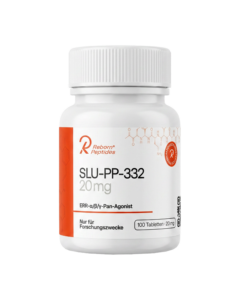
The slu-pp-332 mechanism of action is described pharmacologically as synthetic pan-ERR agonism. It is an acylhydrazone-class small molecule, not a peptide. In the HEK293 co-transfection assay reported by Billon et al. (2023), its EC₅₀ values were ≈ 98 nM (ERRα), 230 nM (ERRβ), 430 nM (ERRγ), with the highest potency at ERRα in that assay (in vitro: HEK293 co-transfection; PMID 36988910; DOI 10.1021/acschembio.2c00720).
EC₅₀ values are assay-dependent concentration measures. They are not transferable between laboratory configurations, are not a universal compound property and do not establish a medical conclusion. “Highest potency” here has only the narrow pharmacological meaning of the reported assay comparison.
The identity-focused FAQ section of the SLU-PP-332 product page covers the separate questions-and-identity layer without changing the class-level interpretation given here.
Which model data the cited studies report
The evidence gathered below is what the cited literature reports on the SLU-PP-332 mechanism of action. It is a reading of the named publications, not a complete survey of the field, and it does not extend beyond the systems named in each study.
Billon et al. (2023) examined receptor activity alongside measurements in C2C12 cells, primary myocytes and mice. The mouse work included a muscle-specific ERRα knockout as a test of ERRα dependence within that experimental framework. These are in vitro and preclinical observations tied to the named systems, not class-wide conclusions (PMID 36988910; DOI 10.1021/acschembio.2c00720).
Wang et al. (2023) studied ERR agonism in aged mice plus in vitro systems. Reported measurements included the mitochondrial-biogenesis markers PGC-1α and Tfam and inflammatory markers in a kidney model. Each is a measured endpoint in that preclinical model and supporting cell context, not a general attribute of the class (PMID 37717940; DOI 10.1016/j.ajpath.2023.07.008).
Moeller et al. (2026) characterised SLU-PP-332 and the separate material SLU-PP-915 in human liver S9 fractions and liver microsomes using LC-HRMS/MS. This is in vitro metabolic and analytical work. SLU-PP-915 is a separate material, and its data must not be transferred to SLU-PP-332 (PMID 41588687; DOI 10.1002/rcm.70039).
Okda et al. (2026) compared the named example with chemical analogues through cell-based functional assays, gene-expression work and computational modelling. This is in vitro plus computational evidence. The analogues are independent compounds and must not be equated with SLU-PP-332 (PMID 41850449; DOI 10.1016/j.ijbiomac.2026.151450).
Bonanni et al. (2025) conducted a pilot study in human primary myoblasts and myotubes derived from muscle biopsies and treated ex vivo in cell culture. This was not administration to humans and was not a clinical study (PMID 40692696; DOI 10.3389/fphys.2025.1616693).
A systematic review published in Revista Médica de Chile in 2026 brings together the existing mechanistic and preclinical literature on this receptor family. Reviews organise and assess existing publications; they do not automatically add new experimental evidence, and the model qualifiers of each primary study they discuss remain in force (PMID 42024694; DOI 10.4067/s0034-98872026000200237).
The guide to study models explains what in vitro, preclinical, computational and review evidence can each support. Related definitions are collected in the knowledge hub.
What is not established
A validated half-life for a named model, matrix and analytical method is not established in the cited evidence. Although pharmacokinetic measurement points in mice were reported, no numerical half-life is derived here. Estimation would not be scientifically defensible because half-lives depend on the investigated system and experimental conditions.
Three boundaries govern interpretation. An EC₅₀ value describes potency in a particular assay. A changed marker records a measurement in the model concerned. A finding in a mouse remains a finding in a mouse. None of these evidence levels, alone or together, establishes an approved medical use.
The same separation applies to class and compound. Receptor-family terminology describes a pharmacological relationship, while a specific experiment supports only its reported endpoint under its reported conditions. Any statement about the SLU-PP-332 mechanism of action therefore stays at the level of receptor activation reported in the cited assays, not a validated pathway in an intact organism.
Sources
Publication titles are intentionally omitted because they contain restricted outcome and indication terminology; identification remains unambiguous through the PMID and DOI records.
- Billon et al. (2023), ACS Chem Biol. Preclinical: mice; in vitro: C2C12, primary myocytes, HEK293. PMID 36988910. DOI
10.1021/acschembio.2c00720. - Wang et al. (2023), Am J Pathol. Aged mice plus in vitro. PMID 37717940. DOI
10.1016/j.ajpath.2023.07.008. - Moeller et al. (2026), Rapid Commun Mass Spectrom. In vitro: human liver S9 fractions, liver microsomes and LC-HRMS/MS; SLU-PP-332 and the separate material SLU-PP-915. PMID 41588687. DOI
10.1002/rcm.70039. - Okda et al. (2026), Int J Biol Macromol. In vitro plus computational. PMID 41850449. DOI
10.1016/j.ijbiomac.2026.151450. - Bonanni et al. (2025), Front Physiol. Pilot study: human primary myoblasts and myotubes from muscle biopsies, ex vivo in cell culture; no administration to humans. PMID 40692696. DOI
10.3389/fphys.2025.1616693. - Systematic review (2026), Rev Med Chil. Systematic review of preclinical and mechanistic literature. PMID 42024694. DOI
10.4067/s0034-98872026000200237.
Research-use statement
All materials referenced on this page are for laboratory research use only. They are not for human or veterinary use. Receptor-family terminology describes a pharmacological classification; it carries no statement about the suitability of any material for a purpose beyond the reported experimental systems. An ERR agonist remains defined by the activity reported in the relevant test system.