≥ 99 % · HPLC
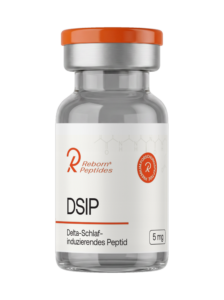
DSIP
Cognition, Mood & Sleep
36,90 €
38,90 €
incl. shipping & VAT

Certificate of analysis per batch

≥ 99 % purity (HPLC)

Shipping across the EU

Delivery in 3–5 business days
Strength: 5 mg
Quantity:

Fast & secure payment
Bacteriostatic water 10 ml
For reconstitution — included free with orders over €70.
Only 70,00 € until your free gift.

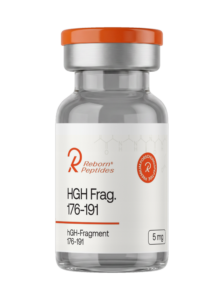
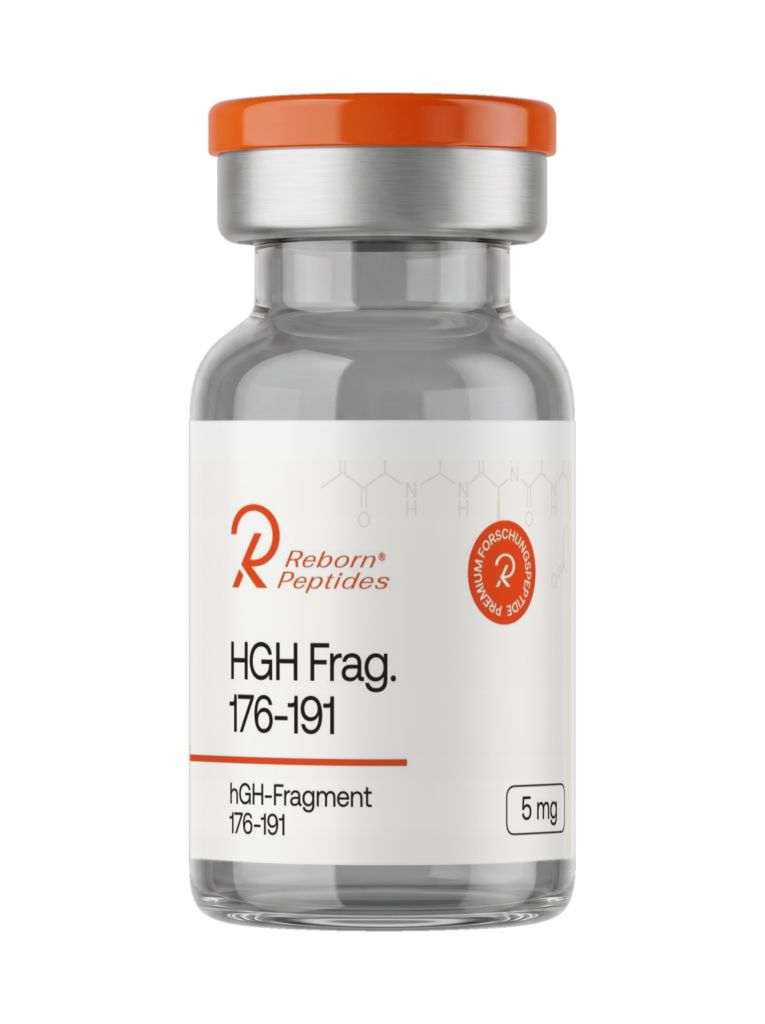
What is HGH Fragment 176-191
HGH Fragment 176-191, also written HGH Frag 176-191 or HGH 176-191, is the native C-terminal 16-residue segment of mature human growth hormone, with the sequence FLRIVQCRSVEGSCGF and phenylalanine at position 176 as its first residue. Sequence ancestry does not make findings for full-length hGH or other terminal fragments transferable to this peptide.
HGH Fragment 176-191 is not AOD-9604: AOD-9604 is the distinct Tyr-modified analogue YLRIVQCRSVEGSCGF, with different identity and analytical records. The material is supplied strictly for laboratory research and is not for use in humans or animals; identity and purity require matching batch documentation and a batch-specific COA.
HGH Fragment 176-191 comprises the final 16 residues of the mature 191-residue hGH chain and begins with native Phe176. The reference sequence, terminal chemistry, oxidation state, counter-ion, label, batch code and analytical documentation must refer to the same material. A database record describes a reference identity but cannot establish the form present in a supplied batch.
The analyte is distinct from 15-residue hGH(177-191), Tyr-modified AOD-9604 and full-length hGH. AOD-9604 begins with a synthetic N-terminal tyrosine, whereas unmodified hGH(176-191) begins with phenylalanine. Their sequences, formulae, masses, database identifiers, evidence and analytical records are not interchangeable.
The cited research includes a preclinical rat experiment in which native hGH(176-191) was one of several C-terminal fragments and a cell-culture study of a multi-component nanoparticle formulation labelled with HGH Fragment 176-191. Findings remain attached to the stated analyte, formulation, model, method and endpoint; the combined formulation does not isolate the peptide's contribution.
For laboratory procurement, product designation, sequence, supplied form, label, batch code, test date, specification and COA should correspond. HPLC reports method-specific chromatographic purity only for the analysed batch and does not by itself establish sequence, counter-ion, terminal chemistry or disulphide connectivity. Binding storage and handling conditions must follow approved product and batch documentation.
Evidence
Native hGH(176-191) was included among several C-terminal fragments in a rat experiment measuring blood glucose, plasma insulin and insulin-tolerance responses under the reported conditions.
Ng et al. 1978 · PMID 645904
Material labelled HGH Fragment 176-191 was studied in a formulation also containing chitosan nanoparticles and doxorubicin; the design does not isolate the peptide's contribution.
Habibullah et al. 2022 · PMID 35783198
Literature and database records do not verify the identity, purity, supplied form, oxidation state or counter-ion of a supplied batch.
Reborn batch documentation · COA with HPLC and MS
Research status
2 selected sources — filterable by study type, each linking straight to the source.
Research Deep Dive
Model-qualified findings in depth — every claim tied to a PubMed-indexed source.
HGH Fragment 176-191, or hGH(176–191), is the native C-terminal 16-residue segment of the mature 191-residue human hGH chain. Its sequence is FLRIVQCRSVEGSCGF, beginning with phenylalanine at position 176. Numbering refers to the mature chain recorded under UniProt P01241, not to the longer preprotein. P01241 identifies the parent protein rather than providing a separate accession for the isolated fragment.
PubChem depicts the reference peptide with a disulphide bond between Cys7 and Cys14 of the fragment, corresponding to Cys182 and Cys189 in mature-chain numbering. The two PubChem records below describe reference structures with that closed bond. They define database identities but do not determine the oxidation state, counter-ion or composition of supplied material.
| Field | Documented reference |
|---|---|
| Sequence | FLRIVQCRSVEGSCGF; 16 residues |
| Starting residue | Phe176, mature-hGH numbering |
| Disulphide connectivity | Cys7–Cys14 of the fragment; Cys182–Cys189 in mature-chain numbering |
| Molecular formulae | C78H123N23O22S2, neutral free peptide; C80H127N23O24S2, acetic-acid-containing record |
| Molecular masses | 1799.1 g/mol, neutral free peptide; 1859.1 g/mol, acetic-acid-containing record |
| PubChem CIDs | 172966177, parent free-peptide record; 172966176, acetic-acid-containing record |
| UniProt reference | P01241, full-length mature human somatotropin at 191 residues, not an accession for the fragment |
| Product identifier | SKU RP-1011 |
Reference formulae, masses and identifiers cannot authenticate a commercial sample. Sequence, terminal chemistry, counter-ion, disulphide state, label and batch code must converge in matching analytical documentation before a supplied material can be assigned this identity.
Research source: Ng et al. 1978 · PMID 645904
Similar catalogue wording can conceal chemically different analytes. Unmodified hGH(176–191), AOD-9604, native hGH(177–191) and full-length mature hGH must therefore remain separate in literature review, procurement and batch documentation. Sequence ancestry is a structural relationship; it is not evidence that related molecules share properties.
The product identity is the native 16-mer beginning with Phe176. Its free-peptide and acetic-acid-containing PubChem records are themselves distinct reference entries.
AOD-9604 is Tyr-hGH(177–191), a separate 16-residue analyte beginning with tyrosine rather than the product's native phenylalanine. Its sequence, formula, mass, registry identifier and analytical record must not be assigned to hGH(176–191).
Native hGH(177–191) contains 15 residues because Phe176 is absent. Full-length mature hGH contains 191 residues; neither analyte is the isolated 16-mer offered under SKU RP-1011.
The distinction controls how evidence is read. Three of the six listed sources concern the shorter native hGH(177–191) or peptides containing that sequence, while one review concerns AOD-9604. Those records cannot fill evidence gaps for unmodified hGH(176–191). A name on an experimental material also does not establish that its sequence, molecular form and analytical identity match a database record or supplied batch.
Delimitation sources: Weerasinghe et al. 1979 · PMID 373464 · Macaulay et al. 1983 · PMID 6307153 · Wilding 2004 · PMID 15134286
This section describes findings in controlled research. The records span preclinical rat models, isolated rat material, a review and a cell-culture formulation. Every observation remains attached to its named analyte, model, method and endpoint; the records do not form one pooled evidence set.
Native hGH(176–191) appeared among several C-terminal fragments in a preclinical rat model measuring blood glucose, plasma insulin and insulin-tolerance responses.
PMID 645904 · DOI 10.1152/ajpendo.1978.234.5.E521Peptides containing hGH(177–191), not hGH(176–191), were examined in vitro in isolated rat islets through radiolabelled-glucose oxidation and pentose-phosphate-shunt measurements.
PMID 373464 · DOI 10.1152/ajpendo.1979.236.1.E4Native hGH(177–191), not hGH(176–191), was studied in a rat tissue and animal model measuring glycogen-synthase and glycogen-synthase-phosphatase activity in rat skeletal tissue.
PMID 6307153 · DOI 10.1016/0003-9861(83)90221-7Native hGH(177–191), not hGH(176–191), was examined in a rat adipose-tissue and animal model measuring lipid-synthesis endpoints and glycerol release.
PMID 8358331 · DOI not listed in PubMedAOD-9604, not unmodified hGH(176–191), was the analyte discussed in this review; a review is secondary literature rather than a direct experiment.
PMID 15134286 · DOI not listed in PubMedMaterial labelled HGH Fragment 176–191 was included with doxorubicin in a multi-component nanoparticle formulation in an in silico plus MCF-7 cell-culture model measuring docking, nanoparticle characteristics and cell viability; the peptide contribution was not isolated.
PMID 35783198 · DOI 10.2147/DDDT.S367586Only Ng 1978 explicitly examined native hGH(176–191), and it did so among several C-terminal fragments in a preclinical rat model. The remaining records concern a different analyte or a multi-component formulation. None authenticates a Reborn Peptides batch.
Evidence map: PMID 645904 · PMID 373464 · PMID 6307153 · PMID 8358331 · PMID 15134286 · PMID 35783198
HGH Fragment 176-191, hGH(176–191), somatotropin fragment 176–191 and HGH Frag 176 191 can denote the same native 16-residue identity when the sequence definition agrees. Abbreviated wording does not relax the requirement to verify the complete sequence, molecular form and batch traceability.
The neutral free-peptide record and the acetic-acid-containing reference record are not interchangeable. Their documented masses differ by 60.0 g/mol, corresponding to the acetic-acid component in CID 172966176. A different counter-ion, terminal chemistry or disulphide state requires its own verified formula and mass; neither reference record proves the composition of supplied material.
Three levels must remain distinct. Database identity describes a curated reference structure. Experimental material is the analyte reported by a publication and remains bounded by that paper's characterisation. Supplied material requires a matching label, specification, batch code and analytical documentation. Agreement at one level cannot be treated as evidence at another.
The six publications do not establish a uniform profile for hGH(176–191). They do not verify identity, content, purity, counter-ion, oxidation state, stability or suitability of a Reborn Peptides batch. Literature frames model-specific questions, whereas batch analysis documents the named sample tested.
Evidence-boundary sources: Ng et al. 1978 · PMID 645904 · Habibullah et al. 2022 · PMID 35783198
No physical form, stated content, counter-ion or storage temperature is asserted here. Each must be reconciled against the released label, product specification and documentation for the applicable batch. Catalogue wording or a database reference cannot establish these properties.
The required documentation chain should connect HGH Fragment 176-191, SKU RP-1011, label, batch code, specification, analytical method, test date and result. A COA should identify the analyte as hGH(176–191) and link every reported result to the tested batch. Any discrepancy should be resolved before the material is assigned to controlled laboratory research.
Any numerical purity statement must be batch-specific and method-specific. HPLC can describe the chromatographic result for the analysed sample, but does not by itself establish complete sequence, counter-ion, terminal chemistry or disulphide connectivity. Identity testing and chromatographic assessment answer complementary questions, and neither result may be transferred to another batch.
HGH Fragment 176-191 is presented to EU laboratories as research material. Published records describe named analytes and experimental systems; they neither certify supplied material nor replace a released specification and matching batch documentation.
Research use only. For laboratory research only. Not for human or veterinary use. Not intended to diagnose, treat, cure or prevent any disease. Not a medicinal product, food or cosmetic.

FAQ
It is the native C-terminal 16-residue segment of mature human growth hormone, with the sequence FLRIVQCRSVEGSCGF and phenylalanine at mature-hGH position 176 as its first residue.
No. AOD-9604 is the distinct Tyr-modified analogue YLRIVQCRSVEGSCGF and has different identity and analytical records.
No. Native hGH(177-191) lacks Phe176 and contains 15 residues. Findings for that shorter analyte cannot be transferred to HGH Fragment 176-191.
One study included native hGH(176-191) among several C-terminal fragments in a preclinical rat model. Another examined a multi-component nanoparticle formulation in silico and in MCF-7 cell culture, so it does not isolate the peptide's contribution.
It is supplied strictly for laboratory research and is not for use in humans or animals. No finding establishes an outcome beyond its cited experimental system.
HPLC can provide a chromatographic purity result for the analysed sample under the stated method. Any purity value applies only to the named batch and its matching COA.
We accept prepayment by SEPA bank transfer as well as credit card. All payments are processed securely and encrypted.
Discreet shipping from the EU, delivery in 3–5 business days. Neutral packaging with no reference to the contents.