Bestseller≥ 99 % · HPLC

GHK-Cu
Regeneration & Longevity
54,90 €
50,90 €
incl. shipping & VAT

Certificate of analysis per batch

≥ 99 % purity (HPLC)

Shipping across the EU

Delivery in 3–5 business days
Strength: 10 mg
Quantity:

Fast & secure payment
Bacteriostatic water 10 ml
For reconstitution — included free with orders over €70.
Only 70,00 € until your free gift.

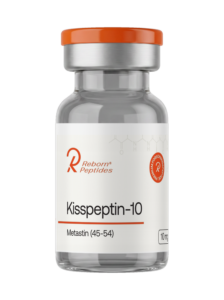
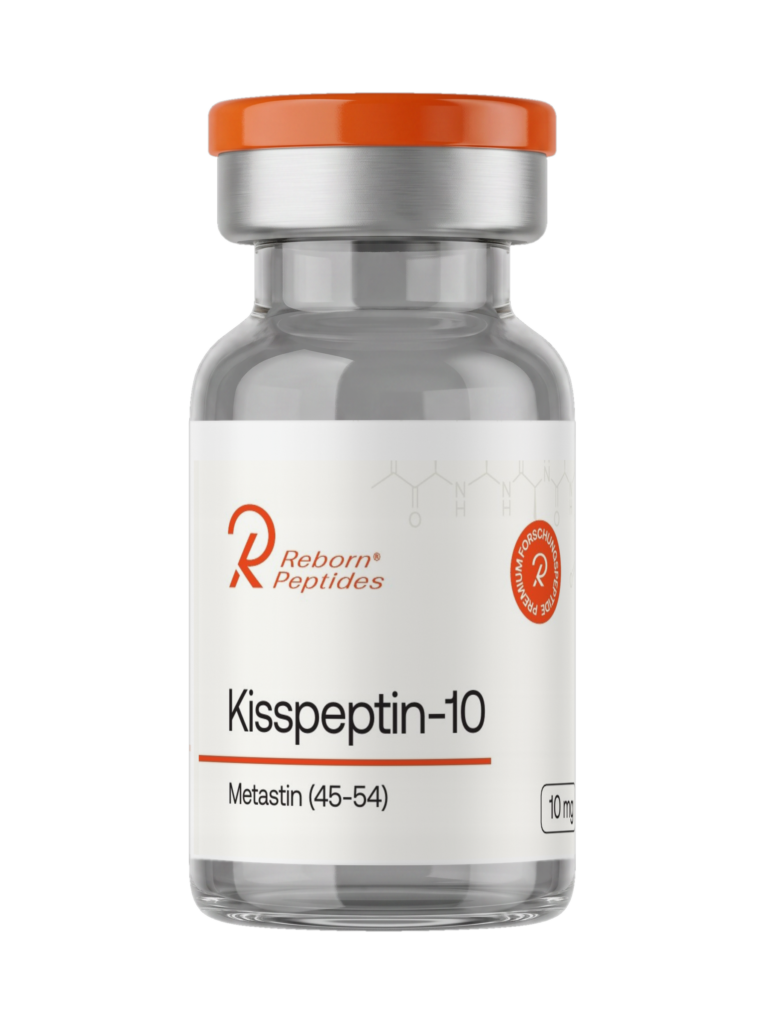
What is Kisspeptin-10
Kisspeptin-10 is the C-terminally amidated decapeptide YNWNSFGLRF-NH2, corresponding to residues 45–54 of the 54-residue KISS1 gene product. The names kisspeptin 10 and KP-10 refer to this same defined decapeptide. Sequence, terminal form, reference identifiers and batch records must agree before identity is assigned to supplied material.
This kisspeptin peptide is offered strictly for controlled laboratory research and is not for use in humans or animals. Published observations remain limited to the stated molecule, model, method and endpoint; they do not establish batch identity, purity or experimental performance.
Kisspeptin-10 is defined by its ten-residue sequence and C-terminal amide. In vitro cellular receptor preparations have been used to examine KISS1-derived peptides and KISS1R/GPR54 pharmacology. Separate mouse and rat models examined pathway-dependent laboratory endpoints, including GnRH-neuron markers, LH, FSH and Kiss1 expression. The molecular boundary matters here: the peptide administered in the rat model was kisspeptin-52, and the further FSH characterisation in the mouse model is attributed to kisspeptin-54. These observations remain confined to their stated molecule, species, preparations and methods and are not performance claims for supplied material.
Kisspeptin-54, also called Metastin, is the 54-residue parent peptide. Kisspeptin-13 and Kisspeptin-14 are longer C-terminal fragments. They are separate molecular entities and are not the same as KP-10; shared origin and overlapping sequence do not make them interchangeable.
Reference identity is documented as follows: PubChem CID 25240297; molecular formula C63H83N17O14; average molecular weight approximately 1302.4 g/mol; CAS 374675-21-5; InChIKey RITKWYDZSSQNJI-INXYWQKQSA-N. These identifiers describe the amidated reference structure and do not identify a physical sample.
A batch-specific COA should connect the product name, batch code, sample, method, test date and result. HPLC may document a chromatographic profile and method-specific purity value for the analysed sample; any purity statement applies only to that tested batch. Kisspeptin-10 is strictly for laboratory research and is not for use in humans or animals.

Evidence
The amidated reference structure is documented as PubChem CID 25240297, C63H83N17O14, approximately 1302.4 g/mol, CAS 374675-21-5 and InChIKey RITKWYDZSSQNJI-INXYWQKQSA-N.
PubChem CID 25240297
KISS1-derived peptides, including the C-terminal decapeptide, were examined in in vitro cellular KISS1R/GPR54 receptor preparations.
Kotani 2001 · PMID 11457843
GPR54-dependent GnRH-neuron markers were examined by comparing receptor-intact and receptor-deficient mice.
Messager 2005 · PMID 15665093
GnRH-neuron markers, LH, FSH and Kiss1 expression were reported only within the cited preclinical rat and mouse designs. The peptide administered by Irwig and colleagues was kisspeptin-52, and the further FSH characterisation by Gottsch and colleagues is attributed in the abstract to kisspeptin-54; neither is a KP-10 endpoint.
Irwig 2004 · PMID 15665556 · Gottsch 2004 · PMID 15217982
HPLC may provide a chromatographic profile and batch-specific purity value, while identity requires matching reference and batch records.
Reborn batch documentation · COA with HPLC
Research status
6 selected sources — filterable by study type, each linking straight to the source.
Research Deep Dive
Model-qualified findings in depth — every claim tied to a PubMed-indexed source.
Kisspeptin-10 is a synthetic, C-terminally amidated decapeptide in the KISS1 gene-product family. Its sequence is YNWNSFGLRF-NH2, corresponding to residues 45–54 of the 54-residue KISS1 gene product. The terminal NH2 denotes an amide rather than a free carboxyl terminus. That distinction matters when formula, mass and sequence records are compared.
The formula and average molecular weight below describe the amidated free reference structure recorded under PubChem CID 25240297. These documentary identifiers define a reference entity; none authenticates a physical sample, establishes its molecular form or reports an analytical result.
| Field | Reference specification |
|---|---|
| Name | Kisspeptin-10 |
| Common abbreviation | KP-10 |
| Class | Synthetic C-terminally amidated decapeptide, KISS1 gene-product family |
| Sequence | Tyr-Asn-Trp-Asn-Ser-Phe-Gly-Leu-Arg-Phe-NH2 (YNWNSFGLRF-NH2) |
| Residue count | 10 (residues 45–54 of the 54-residue KISS1 gene product) |
| Molecular formula | C63H83N17O14 (amidated free reference structure; PubChem CID 25240297) |
| Molecular weight | Approximately 1302.4 g/mol (average value, reference structure) |
| CAS Registry Number | 374675-21-5 |
| PubChem CID | 25240297 |
| InChIKey | RITKWYDZSSQNJI-INXYWQKQSA-N |
Reference identity and batch identity are separate questions. Assignment of supplied material requires batch-linked evidence.
Identity and receptor-pharmacology source: Kotani et al. 2001 · PMID 11457843
In vitro receptor pharmacology identified KISS1R, also called GPR54, as the tested receptor designation and reported binding and activation by KISS1-derived peptides in cellular preparations. In that in vitro study, the C-terminal decapeptide retained agonist potency under the assay conditions. Receptor binding, receptor activation and agonist potency are related but distinct experimental measurements, and none provides batch identification.
In vitro binding records association with the tested receptor preparation under specified assay conditions. It is not an identity test for supplied material.
In vitro activation is a functional readout downstream of receptor engagement in the cellular system. It must remain attached to that preparation and method.
Preclinical rodent comparisons involving receptor-intact and receptor-deficient models examine whether a measured response depends on the studied pathway. They do not turn a model result into a material specification.
Preclinical antagonist pharmacology reported GnRH-neuron activity and LH pulsatility across experimental models. A preclinical mouse model reported GPR54-dependent GnRH-neuron activation, with an LH response absent in the receptor-deficient model. These designs address different questions.
Mechanism sources: Kotani et al. 2001 · PMID 11457843 · Roseweir et al. 2009 · PMID 19321788 · Messager et al. 2005 · PMID 15665093
This section describes findings in controlled research and makes no statement about use. The evidence progresses from in vitro cellular preparations through preclinical rodent models, human genetics studies, a human clinical study and a literature review. Each observation remains bounded by its molecule, model, method and endpoint; no listed publication analyses a Reborn Peptides batch.
In vitro cellular receptor preparations were used to examine GPR54 binding and activation, and the decapeptide retained agonist potency under the tested conditions.
PMID 11457843 · DOI 10.1074/jbc.M104847200Preclinical antagonist pharmacology examined GnRH-neuron activity and LH pulsatility across experimental models. The findings remain antagonist-, model- and endpoint-specific.
PMID 19321788 · DOI 10.1523/JNEUROSCI.5740-08.2009A preclinical mouse model reported GPR54-dependent GnRH-neuron activation and an LH response absent in the receptor-deficient comparison.
PMID 15665093 · DOI 10.1073/pnas.0409330102A preclinical rat model measured c-Fos in GnRH neurons, LH and KiSS-1 mRNA under the reported experimental conditions. The administered peptide was kisspeptin-52, not KP-10.
PMID 15665556 · DOI 10.1159/000083140A preclinical mouse model examined kisspeptin-54 and kisspeptin-10. Both raised LH, while the further FSH characterisation is attributed to kisspeptin-54; Kiss1 mRNA distribution was mapped separately.
PMID 15217982 · DOI 10.1210/en.2004-0431A human genetics study examined GPR54 loss of function alongside a receptor-deficient mouse model. The two evidence levels remain separate.
PMID 14573733 · DOI 10.1056/NEJMoa035322A human family genetics study reported receptor loss of function in the investigated family. It did not test supplied KP-10 material.
PMID 12944565 · DOI 10.1073/pnas.1834399100A human clinical study recorded LH concentration and pulse-frequency endpoints. The finding remains confined to the study design and those measured endpoints.
PMID 21632807 · DOI 10.1210/jc.2011-0089This literature review organised receptor, preclinical, genetics and clinical evidence. It is secondary context and adds no batch analysis.
PMID 22811428 · DOI 10.1152/physrev.00037.2010Evidence map: PMID 11457843 · PMID 19321788 · PMID 15665093 · PMID 15665556 · PMID 15217982 · PMID 14573733 · PMID 12944565 · PMID 21632807 · PMID 22811428
Kisspeptin-10, kisspeptin 10 and KP-10 are names for the same sequence-defined molecule. The punctuation and abbreviation do not create separate compounds. “Metastin 45–54” may also identify this decapeptide because the residue range is explicit.
Kisspeptin-54, also called Metastin, is the 54-residue parent peptide. Kisspeptin-13 and Kisspeptin-14 are longer C-terminal fragments. Shared origin and overlapping sequences do not make these molecular records interchangeable with Kisspeptin-10. Each length requires its own sequence assignment, terminal-form description, identifiers, specification and batch documentation.
“Metastin 45–54” points to the C-terminal decapeptide, whereas “Metastin” without a residue range commonly denotes Kisspeptin-54. A family name cannot justify transferring evidence between peptide lengths.
Naming context: Kotani et al. 2001 · PMID 11457843 · Pinilla et al. 2012 · PMID 22811428
No fill quantity, salt form, storage condition or stability period is asserted here. Those particulars must come from the released label, applicable specification and matching batch documentation. Reference formula, average molecular weight and sequence length do not establish any of them.
For documentary review, the product designation and sequence should agree across the label and specification, while the batch code should connect the material to its COA. The analytical record should identify the tested sample, method, test date and result. Any inconsistency in that chain must be resolved before the record is assigned to the material.
An HPLC purity value is method- and batch-specific and applies only to the tested batch. It cannot be generalised to other material. Chromatography and molecular identity also answer separate analytical questions; a database identifier does not measure purity, and an HPLC result alone does not necessarily establish the complete sequence or molecular form.
Laboratories seeking Kisspeptin-10 research supply in the EU should evaluate reference identity and batch documentation separately. Published papers define investigated models and endpoints; released records define a supplied sample. Neither substitutes for the other.
Kisspeptin-10 is presented solely as research material for controlled laboratory work. The cited evidence establishes no conclusion beyond its named systems and measurements and provides no analytical certification of Reborn Peptides material.
Research use only. For laboratory research only. Not for human or veterinary use. Not intended to diagnose, treat, cure or prevent any disease. Not a medicinal product, food or cosmetic.

FAQ
Identifiers from PubChem (CID 25240297). Species and sequence identity (human KP-10F), salt form and exact molecular weight require matching batch analytics.
It is the C-terminally amidated decapeptide YNWNSFGLRF-NH2, corresponding to residues 45–54 of the 54-residue KISS1 gene product.
No. Scientific literature uses both names for the same amidated decapeptide, provided the sequence and terminal form agree.
No. Kisspeptin-54 (Metastin), Kisspeptin-13 and Kisspeptin-14 are separate molecular entities and are not the same as KP-10.
The cited literature includes in vitro cellular receptor preparations and preclinical mouse and rat models. KISS1R/GPR54, GnRH, LH and FSH findings remain qualified by the specific model, species, method and endpoint.
The applicable COA should link the batch code, sample, analytical method, test date and result. Any HPLC purity value applies only to the tested batch.
It is supplied strictly for laboratory research and is not for use in humans or animals. It is not intended to diagnose, treat, cure or prevent disease.
We accept prepayment by SEPA bank transfer as well as credit card. All payments are processed securely and encrypted.
Discreet shipping from the EU, delivery in 3–5 business days. Neutral packaging with no reference to the contents.