Peptide Blends: Evidence for Multi-Component Research Materials
All materials discussed here are for laboratory research use only. They are not for human or veterinary use. A peptide blend is a research material containing multiple declared components in one container. The relevant evidence begins with what the documentation can establish about that particular multi-component material, rather than with expectations attached to its constituents. This guide therefore keeps the material identity, composition, published literature and batch analytics of peptide blends within that laboratory-research context.
Three evidence levels must remain separate. The first is the material designation or trade name. The second is literature concerning individual components. The third is analytics attributable to a specific batch. Evidence at one level never replaces evidence at another. In particular, findings for isolated substances do not automatically become findings for a peptide mixture containing them. Only documentation that examines or measures the relevant material can support a statement about that material.
Material designation and declared composition
A trade name identifies a catalogue entry; it does not demonstrate identity, content, purity or behaviour in an experimental system. A defensible description of peptide blends therefore starts with the declared components and amounts, followed by records that can be attributed to the material and batch concerned. The name and the evidence have different documentary functions.
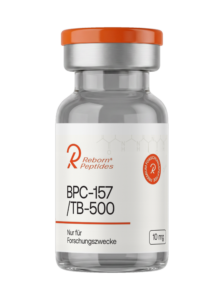
Wolverine Blend, the BPC-157 and TB-500 blend, is declared as BPC-157 5 mg plus TB-500 5 mg per container, with a total amount of 10 mg. GLOW Blend, the GHK-Cu, TB-500 and BPC-157 blend, is declared as GHK-Cu 50 mg, TB-500 10 mg and BPC-157 10 mg, with a total amount of 70 mg. These figures reproduce the declared compositions; they do not by themselves establish a measured batch result.
KLOW Blend, the four-component blend of GHK-Cu, TB-500, BPC-157 and KPV, has a declared total amount of 80 mg. Of the individual amounts, only the KPV position of 10 mg is confirmed in the product record; the allocation of the remaining 70 mg among GHK-Cu, TB-500 and BPC-157 is not stated. The corresponding product page describes the 50/10/10/10 mg split as reconstructed from the documented GLOW allocation and the confirmed KPV position, not as a stated allocation. A reconstructed figure must not be presented as a declared one, and the total alone cannot resolve the three undocumented component-level amounts.
Identity rules for multi-component materials
A composition has no molecular formula and no molecular mass of its own. Neither value may be constructed by adding formulas or molecular masses for the components. Such a calculation would describe an arithmetic combination, not the identity of one molecule, because the declared material contains multiple distinct components. Peptide blends must instead be documented through the identity of every declared component and the composition in which those components are supplied.
Analytical requirements likewise apply to each component separately. Each named constituent requires an unambiguous identity assignment and a separate content result. Evidence identifying BPC-157 does not identify TB-500, and evidence identifying GHK-Cu does not identify KPV. The multi-component record must also remain attributable to the complete material. This component-level approach is consistent with the broader classification of research compounds, which treats defined mixtures as compositions rather than individual molecular entities.
Identity language must also preserve distinctions within the component literature. Esposito et al. 2012 (PMID 22962027) reports the detection and analytical identification, in TB-500, of the N-terminal acetylated 17-23 fragment of human thymosin beta 4 (Ac-LKKTETQ). The abstract states no identity for the TB-500 formulation as a whole; it therefore neither equates that formulation with full-length thymosin beta 4 nor rules the equation out. That scope matters when a component name is reconciled with analytical records. A familiar designation cannot extend what the cited analysis actually established.
Limits of evidence from individual components
A scientific paper examines a defined material in a particular model system and against specified endpoints. Those features bound its conclusions. A study of topical BPC-157 in an alkali-burn rat model and in endothelial cell culture is not a study of BPC-157 together with TB-500 as declared for Wolverine Blend. Equally, a cell-culture paper concerning GHK-Cu does not examine GLOW Blend as the declared three-component material.
The same boundary applies regardless of how many component papers are assembled. Findings from component-level studies cannot be added to create a finding for a four-component material such as KLOW Blend. Multi-compound research peptides are distinct test materials whose composition, experimental conditions, controls and endpoints would have to be expressly documented before an observation could be assigned to the combination.
One cited work does examine a two-component combination: Biçer et al. compared control, BPC-157, TB-500 and both substances combined in four groups of eight rats in an Achilles tendon repair model, and reported no additional benefit for the combined arm over either substance alone. The combined arm did differ significantly from the control arm on total Movin scores; the reported absence of benefit is therefore measured against the single-substance arms, not against the untreated control. That work examines a surgical repair model, not a declared composition or a commercial batch, and the abstract describes its findings as preliminary and calls for further investigation. No cited work examines the three-component composition of GLOW Blend or the four-component composition of KLOW Blend. This finding is deliberately limited to the cited corpus. Within this corpus, component findings cannot be added, transferred or treated as evidence for the combination.
This limitation works in both directions. An expected result does not substitute for a measured result, and the absence of a combination finding in these papers establishes neither that isolated observations would add together nor that they would fail to do so. A source supports a conclusion about the combination only when the investigated material, model, conditions and endpoints match that combination. Otherwise, it remains component literature.
Batch analytics and certificate scope
Published literature and batch analytics answer different questions. A publication reports an experiment; a certificate of analysis records measurements for a specified material and batch under stated methods. For peptide blends, analytics must identify every declared component separately and report the content of each component separately. A total-amount statement cannot replace those component-specific results.
The document-to-material link must also be explicit. The material name, batch identifier and listed components must correspond to the object examined. A COA for BPC-157 alone is not a COA for a multi-component material containing BPC-157. Conversely, a COA for the complete composition is not analytical evidence for BPC-157 supplied separately. A shared component name does not make the records interchangeable.
Purity statements are exclusively batch-specific. They apply only when the COA unambiguously identifies the relevant material and batch and attributes the reported measurement to them. A purity result from another batch, an isolated component or a differently composed peptide mixture cannot be carried across. The guide to understanding the COA explains how material designation, batch code, method and result should remain connected.
KLOW Blend, the 80 mg four-component material, presents an additional documentation limit. Because only the four component names, the total amount and the 10 mg KPV position are documented, analytics for the other three components cannot be assessed against assumed individual values. Separate documented content results would be required. Until such values appear in attributable records, the reconstructed distribution among GHK-Cu, TB-500, BPC-157 and KPV remains unconfirmed by the product record.
Evidence discipline for peptide blends
Reliable evidence handling depends on keeping the three levels visible. A material designation identifies the catalogue object. Component publications describe experiments on the substances they actually examined. Batch analytics document measurements for the specified supplied material. None performs the function of another, even when the same component names appear across all three.
This distinction prevents a trade name such as Wolverine Blend, GLOW Blend or KLOW Blend from becoming an analytical claim, a component paper from becoming combination evidence or a result for one batch from becoming a general purity statement. It also preserves uncertainty where documentation is incomplete. For the four-component composition, the correct record is that only the KPV position is documented and the other three amounts are not, rather than an estimate derived from 80 mg.
All materials described here are exclusively for research purposes and laboratory research. They are not for human or animal use and are not intended for diagnostic, therapeutic or preventive purposes.
Sources
Four of these works examine components separately; Elliott et al. tests several peptides side by side. One work, Biçer et al., examines a two-component combination and is discussed above.
- Huang et al. 2015 — Drug Design, Development and Therapy 9:2485-99 — alkali-burn rat model in vivo and human umbilical vein endothelial cell (HUVEC) assays in vitro — PMID 25995620 — DOI 10.2147/DDDT.S82030
- Esposito et al. 2012 — Drug Testing and Analysis 4(9):733-8 — HPLC/high-resolution mass spectrometry; detects and identifies the N-terminal acetylated 17-23 fragment of human thymosin beta 4 (Ac-LKKTETQ) in TB-500; the abstract states no identity for the formulation as a whole — PMID 22962027 — DOI 10.1002/dta.1402
- Maquart et al. 1988 — FEBS Letters 238(2):343-6 — fibroblast cultures in vitro; fibroblast species not stated in the abstract — PMID 3169264 — DOI 10.1016/0014-5793(88)80509-x
- Elliott et al. 2004 — The Journal of Investigative Dermatology 122(4):1010-9 — HaCaT and normal human keratinocytes plus MC-1R-transfected Chinese hamster ovary cells in vitro; tests alpha-MSH, KPV/KP-D-V and ACTH peptides — PMID 15102092 — DOI 10.1111/j.0022-202X.2004.22404.x
- Biçer et al. 2026 — Joint Diseases and Related Surgery 37(3):822-837 — rat Achilles tendon repair model, four arms of eight (control, BPC-157, TB-500, combination); combined arm significantly better than control on total Movin scores, but no additional benefit over either substance alone — PMID 42542926 — DOI 10.52312/jdrs.2026.2951