≥ 99 % · HPLC
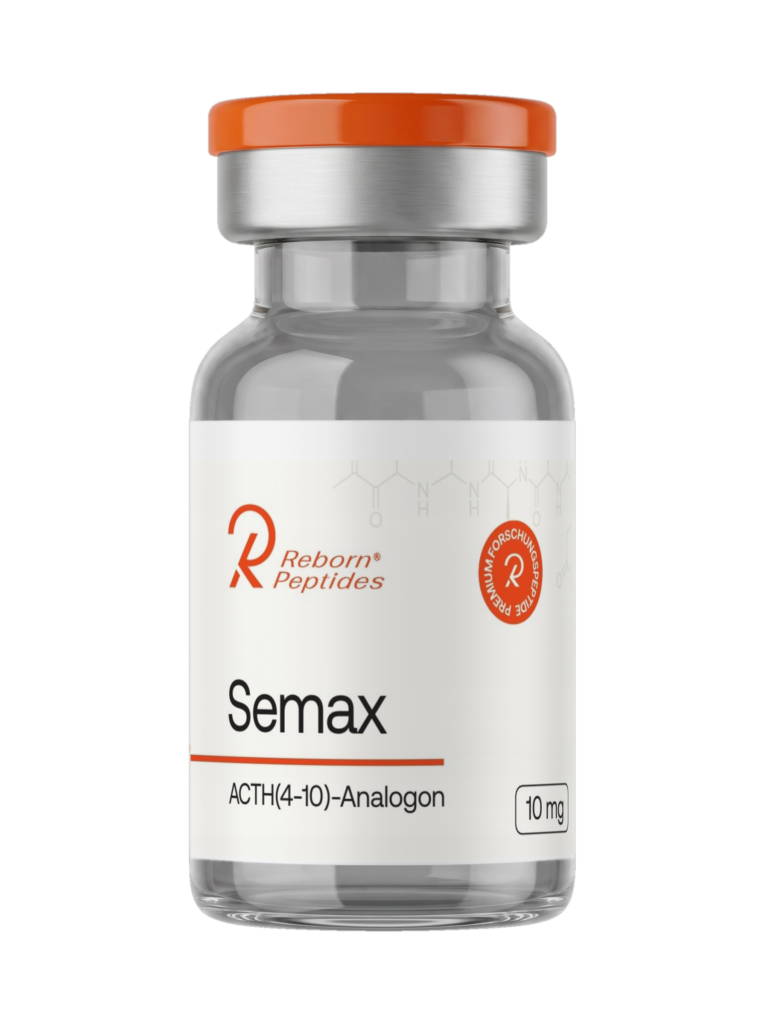
Semax
Cognition, Mood & Sleep
44,90 €
45,90 €
incl. shipping & VAT

Certificate of analysis per batch

≥ 99 % purity (HPLC)

Shipping across the EU

Delivery in 3–5 business days
Strength: 2 mg
Quantity:

Fast & secure payment
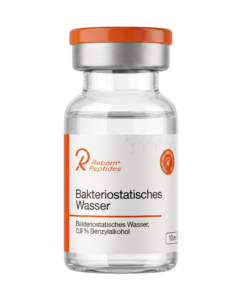
Bacteriostatic water 10 ml
For reconstitution — included free with orders over €70.
Only 70,00 € until your free gift.

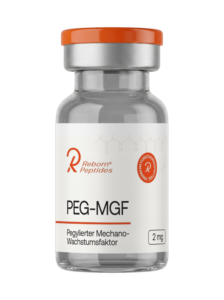
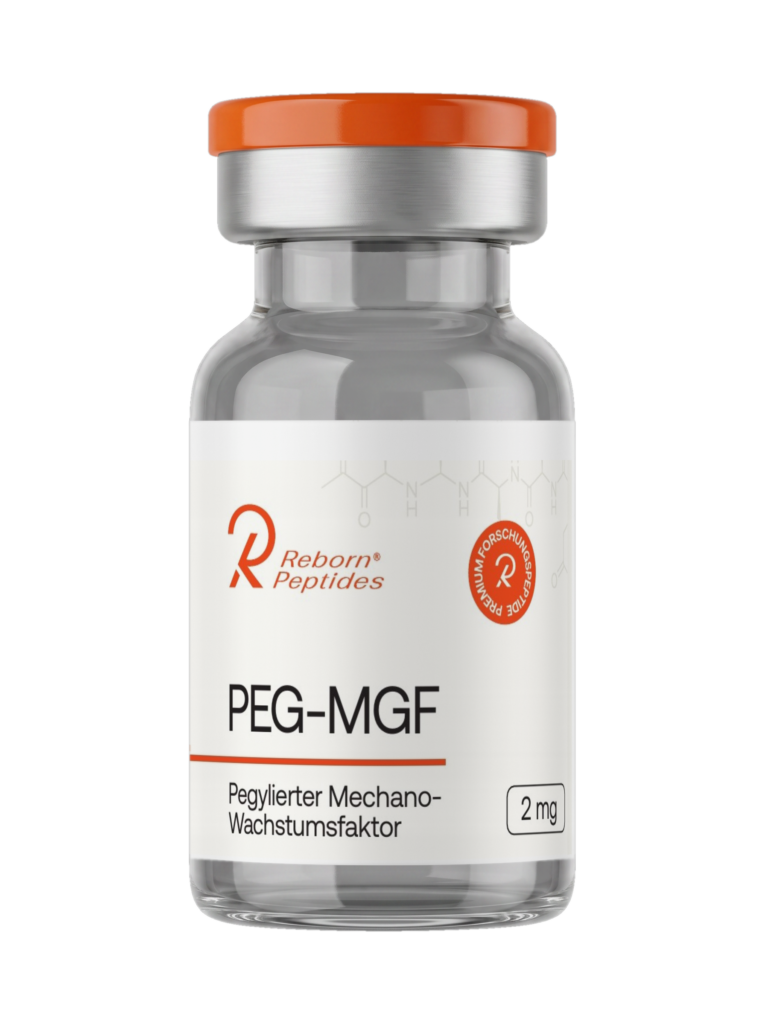
What is PEG-MGF
PEG-MGF is a PEGylated synthetic analogue of the C-terminal E-domain peptide associated with IGF-1Ec, the splice variant commonly called mechano growth factor. Published identity values for the native, non-PEGylated 24-residue peptide do not define the supplied PEG conjugate.
The material is offered strictly for laboratory research and is not for use in humans or animals. Product identity, PEG chemistry, content and purity require the matching specification, batch code and batch-specific COA.
PEG MGF denotes an analogue in which polyethylene glycol is conjugated to an IGF-1Ec E-domain peptide construct. PEG-MGF is the same catalogue identity, while the precise sequence, terminus and conjugation site remain batch-specific. Native-peptide formulae, sequences and database records cannot fill those product-specific gaps.
Published evidence concerns native MGF, IGF-1Ec expression or synthetic E-domain peptides rather than the supplied PEGylated analogue. It spans cell cultures, tissue constructs, preclinical animal models, a human physiological protocol and reviews. Every observation remains limited to its named molecule, model, method and endpoint.
PEGylation is described as a stability-oriented design strategy, but that rationale does not establish equivalence to the native peptide, a particular persistence value or any experimental outcome. HPLC and MS results must be interpreted against the defined conjugate and method.
Research procurement should connect the exact sequence, terminus, PEG chemistry, total mass, salt form, label, batch code and analytical methods with the applicable COA. Any purity statement applies only to the corresponding tested batch.

Evidence
An in vitro study reported different proliferation and differentiation endpoints for the IGF-I Ec E-domain peptide and mature IGF-I; the comparison does not concern PEG-MGF.
Yang et al. 2002 · PMID 12095637
Studies reported migration, activation and fusion endpoints in cultured human myogenic precursor or progenitor cells; these were cell models, not observations in people.
Mills et al. 2007 · PMID 17156777 · Kandalla et al. 2011 · PMID 21354439
Research reported model-specific endpoints for C-terminal IGF-1Ec peptides in cerebral-ischaemia and dopaminergic-neuron systems.
Dluzniewska et al. 2005 · PMID 16144956 · Quesada et al. 2009 · PMID 19735655
Product designation, sequence, PEG chemistry, batch code and analytical records must refer to the same material; purity applies only to the tested batch.
Reborn batch documentation · COA with HPLC and MS
Research status
14 selected sources — filterable by study type, each linking straight to the source.
Research Deep Dive
Model-qualified findings in depth — every claim tied to a PubMed-indexed source.
PEG-MGF is a PEGylated synthetic analogue of the C-terminal E-domain peptide associated with IGF-1Ec, commonly called mechano growth factor. Published identity values belong to native, non-PEGylated material and do not define the supplied conjugate.
| Field | Reference specification |
|---|---|
| Product designation | PEG-MGF; PEG MGF; PEGylated IGF-1Ec C-terminal E-domain peptide analogue |
| Parent context | Mechano growth factor = IGF-1Ec, a mechanically induced IGF-1 splice variant |
| Native peptide length | Approximately 24 residues; native, non-PEGylated literature reference, not product confirmation |
| Frequently cited native 24-mer sequence | YQPPSTNKNTKSQRRKGSTFEEHK; native, non-PEGylated literature reference |
| Alternative form | Ends in …FEERK; native, non-PEGylated literature/database form; neither form is designated uniquely correct |
| Native molecular formula | C121H199N41O40; PubChem reference for the native, non-PEGylated 24-mer |
| PubChem CID | 175675731; native, non-PEGylated 24-mer only |
| CAS Registry Number | No standard CAS is indexed for the MGF E-domain peptide or the PEGylated analogue |
| Product sequence and terminus | Batch-specific; verify against the released specification and COA |
| PEG chemistry and attachment site | Batch-specific; verify against the released specification and COA |
| Product total molecular mass and salt form | Batch-specific; verify against the released specification and COA |
| Physical form, SKU and stated content | SKU RP-1020. The catalogue records lyophilised material at 2 mg per vial; these entries require confirmation against the label and batch documentation |
| Purity | Report only for the tested batch and applicable COA |
| Intended use | Research use only; laboratory research; not for human or veterinary use |
No indexed standard CAS is a documented finding, not an unresolved field. Native references cannot authenticate a conjugate. A record connects designation, batch code, specification and applicable COA.
Identity context: Yang & Goldspink 2002 · PMID 12095637
PEGylation denotes conjugation of polyethylene glycol to an E-domain peptide construct. As a chemical concept, it is used to investigate extended circulation relative to a free peptide. This does not establish a product persistence value or equivalence with native MGF.
Polymer length, attachment chemistry and conjugation site affect the expected total mass and may introduce conjugate heterogeneity.
An HPLC profile can differ from that of the free peptide. MS interpretation depends on a defined conjugate and method.
Native-peptide formulae, sequences and database records cannot fill product-specific identity fields for PEG-MGF.
The supplied material's sequence, terminus, PEG composition, attachment site, total mass and salt form require batch-specific specification and COA reconciliation. HPLC may provide a batch-specific chromatographic result; MS may support identity for the defined conjugate. Neither establishes every attribute alone.
Design context: Dai et al. 2010 · PMID 20494600
This section describes findings in controlled research and makes no statement about use. Every cited record concerns a native or synthetic, non-PEGylated E-domain peptide, or endogenous splice-variant expression—not the supplied PEG conjugate. Model, analyte, method and endpoint delimit each entry.
A non-PEGylated IGF-I Ec E-domain peptide was compared with mature IGF-I in a myoblast model; PEG-MGF was not studied.
PMID 12095637Cells and tissue constructs were used to examine mechanically regulated endogenous IGF-I splicing; no PEG conjugate was tested.
PMID 15389530Cultured human myogenic precursor cells were assessed with a synthetic, non-PEGylated MGF E-domain peptide; supplied PEG-MGF was not studied.
PMID 17156777Normal and altered muscle-tissue models were used to quantify progenitor-cell endpoints; the work did not characterise PEG-MGF.
PMID 17531227Human muscle progenitor-cell cultures from donors of different ages were assessed; no PEG conjugate was investigated.
PMID 21354439Cultured porcine satellite cells provided model-specific cellular and transcription-factor endpoints for non-PEGylated material.
PMID 22875667Rabbit mesenchymal-cell culture was used for cellular differentiation and PI3K/AKT measurements; PEG-MGF was not characterised.
PMID 25588515A preclinical rat model connected endogenous IGF-I splicing after local tissue damage with satellite-cell activation; it was not a PEG-MGF study.
PMID 12692175A preclinical cerebral-ischaemia model examined a non-PEGylated C-terminal IGF-1Ec peptide, not supplied PEG-MGF.
PMID 16144956A preclinical dopaminergic-neuron model examined a C-terminal peptide and haem oxygenase-1 induction; PEG-MGF was not studied.
PMID 19735655A human physiological protocol measured endogenous IGF-I splice-variant expression in biopsies. It was not a reagent study or an investigation of PEG-MGF.
PMID 12562960A review considered mechanical signalling and IGF-I gene splicing; it did not provide batch evidence for a PEG conjugate.
PMID 16024511A review discussed IGF-I splicing, MGF expression and altered muscle models, not the supplied conjugate.
PMID 16463438A review addressed IGF-1Ec expression and regulation across tissue models; it did not characterise PEG-MGF.
PMID 20494600Cell, tissue, animal and endogenous-expression records remain model-specific. None establishes sequence, PEG chemistry, identity, purity or stability for a supplied batch.
Study sources: the fourteen linked PubMed records above define this model-qualified evidence map.
PEG-MGF and PEG MGF denote the same catalogue identity. Mechano growth factor, MGF peptide and IGF-1Ec E-domain peptide describe the parent splice-variant or peptide context. Native MGF, endogenous expression, free synthetic peptide and PEG-MGF are not analytically interchangeable.
PEG-MGF is also distinct from IGF-1 LR3, an 83-residue long-chain IGF-1 analogue. Mature recombinant IGF-1, known as mecasermin or Increlex, is another separate identity. PEG-MGF concerns an analogue of an IGF-1Ec E-domain peptide, whereas IGF-1 LR3 and mecasermin concern mature IGF-1 constructs. Sequence boundaries, molecular records and study findings belonging to one must not be assigned to another.
Classification cannot replace analysis. The specification defines batch attributes; results document a tested sample under named methods. The literature does not show that PEGylation preserves endpoints reported for a free peptide.
Classification sources: Hameed et al. 2003 · PMID 12562960 · Goldspink 2006 · PMID 16463438
The catalogue records SKU RP-1020, lyophilised material and 2 mg per vial. These presentation entries are not released specifications and require label and batch-document confirmation. No storage temperature or stability interval is inferred; binding conditions must come from released product information.
A batch COA should connect product designation, sample reference, batch code, analytical method, analysis date and result. The exact sequence, terminus, PEG chemistry, attachment site, total molecular mass and salt form should be reconciled against the released specification and applicable COA. Any numerical purity statement applies only to the tested batch and stated method; this page does not assert that a released COA or MS evidence is already available for an offered batch.
PEG-MGF is supplied to EU laboratories as research material. Publications do not certify delivered identity, content, form, purity or stability. Review should connect label, specification, batch code and analytical documentation.
Research use only. For laboratory research only. Not for human or veterinary use. Not intended to diagnose, treat, cure or prevent any disease. Not a medicinal product, food or cosmetic.

FAQ
The following values refer to the native, non-PEGylated MGF 24-mer (PubChem CID 175675731). The exact sequence and terminus, PEGylation chemistry, total molecular weight and salt form of the PEG-MGF product require batch-specific quality documentation. Product name: PEG MGF (PEGylated Mechano Growth Factor). Description: PEGylated synthetic analogue of the MGF C-terminal E-domain peptide. Parent molecule: MGF = Mechano Growth Factor = IGF-1Ec (a mechanically induced splice variant of the IGF-1 gene). Bioactive motif: C-terminal E-domain peptide (~24 amino acids). Sequence (native human 24-mer): YQPPSTNKNTKSQRRKGSTFEEHK (frequently cited) — an alternative literature/database form ends in `…FEERK`; synthetic variants often contain D-amino acids in the central QRRK motif and/or N-terminal PEGylation — the exact form requires the matching COA. PubChem CID (native 24-mer): 175675731. Molecular formula (native 24-mer): C121H199N41O40. Molecular weight (native 24-mer): ≈ 2868.1 g/mol — free peptide; the PEGylated product has a higher mass due to the PEG component, and the total molecular weight requires the matching COA. PEG-MGF total molecular weight / PEG chemistry: — depends on the PEG used; requires the matching batch COA. CAS: — no standard CAS is indexed for the MGF E-peptide or its PEGylated analogue. Salt form: commonly listed as lyophilised acetate/TFA salt — the supplied form requires the matching COA. Regulatory status: research peptide, supplied strictly for laboratory research and not as a medicinal product; distinct from Mecasermin/Increlex (mature IGF-1).## Research Overview
In studies, the MGF/E-domain peptide was examined in models of myoblast proliferation and differentiation, satellite/muscle-progenitor-cell activation, mechanotransduction and neuronal endpoints. In myoblast models, Yang & Goldspink reported increased proliferation and reduced differentiation with the MGF E-peptide, a pattern distinct from mature IGF-1 [Yang & Goldspink 2002]. In a preclinical rat tissue model, MGF splicing was associated with muscle satellite-cell activation after local tissue injury [Hill & Goldspink 2003], while satellite-cell experiments examined downregulation of myogenic transcription factors [Qin 2012].
In human muscle-progenitor-cell models, a synthetic MGF E-domain peptide was examined for migration-related activity [Mills 2007], and the MGF E-peptide was examined for cell activation and fusion potential across age groups [Kandalla 2011]. A human skeletal-muscle study reported increased MGF expression following high-intensity resistance exercise [Hameed 2003]. In vitro studies examined mechanical signals directing IGF-1 splicing towards the MGF variant [Cheema 2005; Goldspink 2005]. Altered IGF-1 splicing and reduced MGF expression were also associated with muscle-wasting models [Goldspink 2006].
Beyond muscle-cell research, the C-terminal MGF peptide was examined for neuronal-loss endpoints in a preclinical cerebral-ischaemia model [Dluzniewska 2005] and for dopaminergic-neuron endpoints and haem oxygenase-1 (HO-1) induction in a preclinical model [Quesada 2009]. Mesenchymal stem-cell models examined proliferation, osteogenic differentiation and PI3K/AKT signalling [Tong 2015], while a review addressed IGF-1Ec expression and regulation across tissues [Dai 2010].
These publications describe myoblast and satellite-cell biology, mechanotransduction and neuronal research endpoints within their respective models. They do not establish properties of supplied PEG-MGF material. Reborn supplies this product strictly for laboratory research, not for use in humans or animals.
Storage requirements and batch specifications are stated in the applicable COA and specification documents. This product is supplied exclusively for in vitro and laboratory research and is not intended for use in humans or animals.
PEG-MGF is a PEGylated analogue of a C-terminal E-domain peptide associated with IGF-1Ec, commonly called mechano growth factor.
No. Published sequence, formula and PubChem data concern native, non-PEGylated material and cannot identify the supplied PEG conjugate.
The literature examines native MGF, IGF-1Ec expression or synthetic E-domain peptides in cell, tissue, animal and human physiological research models. It does not directly characterise the supplied PEGylated analogue.
No. PEGylation is described as a stability-oriented design strategy, but it does not prove equivalence to the native peptide, establish a particular persistence value or predict an outcome.
The exact sequence, terminus, PEG chemistry, total mass, salt form and analytical results must be connected to the matching batch documentation and COA. Purity is batch-specific.
It is offered exclusively for controlled laboratory research and is not intended for human or veterinary use.
We accept prepayment by SEPA bank transfer as well as credit card. All payments are processed securely and encrypted.
Discreet shipping from the EU, delivery in 3–5 business days. Neutral packaging with no reference to the contents.