≥ 99 % · HPLC
DSIP
Cognition, Mood & Sleep
36,90 €

54,90 €
incl. shipping & VAT

Certificate of analysis per batch

≥ 99 % purity (HPLC)

Shipping across the EU

Delivery in 3–5 business days
Strength: 50 mg
Quantity:

Fast & secure payment

Delivery: 02.11. – 03.11.
Bacteriostatic water 10 ml
For reconstitution — included free with orders over €70.
Only 70,00 € until your free gift.

What is GHK-Cu
GHK-Cu is a copper(II) complex of the Gly-His-Lys sequence. Public registers contain several records for copper-bound forms with differing stoichiometry, protonation and mass, so the substance name alone does not identify the supplied material. The released product specification, label and matching batch documentation must establish the applicable form.
The free tripeptide glycyl-L-histidyl-L-lysine has the distinct reference identifiers PubChem CID 73587, CAS 49557-75-7 and ChEBI CHEBI:75430, with formula C14H24N6O4 and molecular weight 340.38 g/mol. The identifiers, formula and molecular weight of the free tripeptide must not be assigned to the copper complex.
Published work examines separate collagen-synthesis, MMP-2-, growth-factor-, IL-6- and skin-layer-penetration endpoints in defined in vitro systems, plus connective-tissue components in a preclinical rat model. The material is supplied strictly for laboratory research, not for use in humans or animals.
GHK-Cu denotes a copper(II) complex of the tripeptide sequence Gly-His-Lys. The catalogue expression ghk-cu peptide is treated here as a designation for the copper-bound research substance, but naming alone cannot establish its precise chemical form. Public registers contain multiple copper-complex records that differ in GHK:Cu stoichiometry, protonation and molecular mass, including 1:1 forms and a 2:1 bis-GHK form. Which record applies must follow from the released product specification, label and matching batch documentation.
The free tripeptide glycyl-L-histidyl-L-lysine is a separate reference substance. PubChem CID 73587, CAS 49557-75-7, molecular formula C14H24N6O4, molecular weight 340.38 g/mol and ChEBI CHEBI:75430 describe that uncomplexed L-configured sequence. They do not identify the copper-bound material and must not be transferred to it. Copper binding is scientifically material: one fibroblast-culture publication attributed its collagen-synthesis observation to the tripeptide-copper complex rather than the free sequence. This is a model-specific distinction, not analytical identification of a commercial batch.
The cited source set is wholly preclinical. In vitro studies separately examine collagen synthesis, MMP-2 expression, cell-growth and growth-factor expression, VEGF and bFGF, TNF-alpha-dependent IL-6 secretion, and layer-dependent transport through human skin sections. A rat model measures connective-tissue components including collagen and glycosaminoglycans. Human-derived fibroblasts and skin sections are laboratory models, not clinical evidence. These distinct markers do not establish one unified mechanism, and transport measurements do not establish consequences outside the tested system.
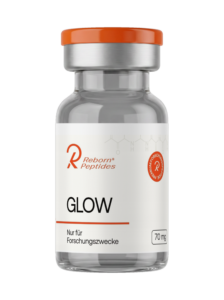
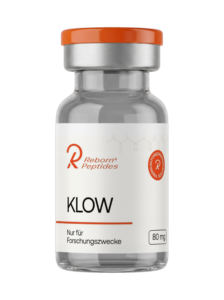
GLOW Blend and KLOW Blend are separate catalogue positions that list GHK-Cu as a component. The presence of GHK-Cu in those blends does not make their analytical records, literature or batch documentation transferable to the standalone GHK-Cu product or vice versa.
For laboratory acquisition of GHK copper peptide, the product designation, applicable specification, batch code, analytical methods and matching COA must form one traceable record. HPLC can document a chromatographic profile and a method-specific purity value only for the tested batch; it does not by itself resolve copper-complex stoichiometry or every identity question.
GHK-Cu is supplied strictly for laboratory research, not for use in humans or animals.

Evidence
The free Gly-His-Lys sequence has defined reference identifiers, but several public records describe copper-bound forms with differing stoichiometry, protonation and mass; only the released specification and batch records can establish the supplied form.
Public chemical-register records checked 22 August 2026
Collagen synthesis and MMP-2 expression were measured in separate fibroblast-culture studies; neither marker establishes a unified mechanism.
Maquart et al. 1988 · PMID 3169264; Simeon et al. 2000 · PMID 11045606
Normal, irradiated and serum-free fibroblast models were used for distinct cell-growth, VEGF-, bFGF- and other growth-factor-expression measurements.
Pollard et al. 2005 · PMID 15655171; McCormack et al. 2001 · PMID 11176716
Free Gly-Gly-His and Gly-His-Lys peptides and their copper complexes were compared for TNF-alpha-dependent IL-6 secretion in normal human dermal fibroblasts under defined in vitro conditions.
Gruchlik et al. 2012 · PMID 23285694
Layer-dependent penetration was measured in human skin sections in vitro; this analytical endpoint does not establish consequences in another system.
Hostynek et al. 2010 · PMID 20703511
Connective-tissue components were measured in a preclinical rat model and remain specific to that species, protocol and endpoint set.
Maquart et al. 1993 · PMID 8227353
The cited set contains primary preclinical studies only. Related review and bioinformatics literature includes work from the same author group and does not add independent primary confirmation to this set.
Source-set assessment
Any HPLC purity value applies only to the tested batch and documented method; chromatography alone does not resolve every identity question, including complex stoichiometry.
Released product specification and matching COA
Research status
7 selected sources — filterable by study type, each linking straight to the source.
Research Deep Dive
Model-qualified findings in depth — every claim tied to a PubMed-indexed source.
GHK-Cu designates a complex of the tripeptide glycyl-L-histidyl-L-lysine with copper(II). GHK records the sequence Gly-His-Lys. The sequence and its copper-bound description are chemically distinct reference layers. Literature describes the sequence as endogenous, but that description supplies neither a concentration nor an identity assignment for commercial material.
The public-register values below are established for the free, L-configured tripeptide. The short name GHK-Cu alone does not resolve GHK-to-copper ratio, counter-ion, hydration, protonation or charge representation.
| Field | Reference specification |
|---|---|
| Designation | GHK-Cu / GHK copper peptide |
| Chemical class | Complex of the tripeptide glycyl-L-histidyl-L-lysine with copper(II) |
| Sequence | Gly-His-Lys |
| PubChem CID — free tripeptide | 73587 |
| CAS — free tripeptide | 49557-75-7 |
| Molecular formula — free tripeptide | C14H24N6O4 |
| Molecular weight — free tripeptide | 340.38 g/mol |
| ChEBI — free tripeptide | CHEBI:75430 |
| Copper complex | Multiple public registry records with differing stoichiometry, protonation and mass exist, so no identifier for the supplied material is stated here. They include 1:1 forms and a 2:1 bis-GHK form; acetate and hydrate forms also carry their own records. PubChem CID 165429100 is one 1:1 representation, while CID 133697840 is a 2:1 representation; these examples document ambiguity and are not product identities. |
These values describe database reference structures, not the commercial batch. Values for the free peptide must not be transferred to the copper complex. Naming or a register match does not authenticate supplied material.
Chemical distinction in a cell model: Maquart et al. 1988 · PMID 3169264
The cited experiments address separate measurement classes. They do not establish a shared causal chain, primary molecular target, receptor interaction or direct binding claim. Even when observations appear in related fibroblast systems, culture conditions, timing, comparator and assay define what each publication can support.
Fibroblast cultures were used separately to measure collagen synthesis and MMP-2 expression. A rat protocol measured connective-tissue components including collagen and glycosaminoglycans. These readouts are not interchangeable.
Normal and irradiated human fibroblasts supported cell-growth and growth-factor-expression measurements. A serum-free fibroblast model measured VEGF and bFGF, while normal human dermal fibroblasts were used to measure TNF-α-dependent IL-6 secretion.
Human skin layers in vitro were used to characterise layer-dependent penetration. Detection across layers is a transport measurement, separate from cellular marker assays.
Maquart and colleagues attributed their 1988 collagen-synthesis finding in cultured fibroblasts to the tripeptide–copper complex rather than the free tripeptide. That attribution describes the tested cell system; it is not a general substance property and supplies no transfer claim. Simeon and colleagues later measured MMP-2 expression in another fibroblast culture design. McCormack and colleagues examined VEGF and bFGF in a serum-free fibroblast model. Gruchlik and colleagues compared free Gly-Gly-His and Gly-His-Lys peptides with their copper complexes in measurements of TNF-α-dependent IL-6 secretion in normal human dermal fibroblasts.
Marker change, correlation and direct molecular interaction are different propositions. None should be inferred from another. Human-derived cells remain an in vitro model, and their origin does not turn a culture experiment into clinical evidence.
Endpoint sources: Simeon et al. 2000 · PMID 11045606 · McCormack et al. 2001 · PMID 11176716 · Gruchlik et al. 2012 · PMID 23285694
This section describes findings in controlled research and makes no statement about use. The records are ordered by model type: in vitro fibroblast cultures, a serum-free culture, human skin layers in vitro, and then a preclinical animal model. This is a wholly preclinical source set, with no human intervention study.
Fibroblast cultures measured collagen synthesis and MMP-2 expression separately. The former was attributed in that experiment to the tripeptide–copper complex rather than free GHK.
PMID 3169264 · PMID 11045606A serum-free fibroblast model measured VEGF and bFGF. In normal human dermal fibroblasts, free Gly-Gly-His and Gly-His-Lys peptides and their copper complexes were compared using a TNF-α-dependent IL-6 secretion readout.
PMID 11176716 · PMID 23285694Normal and irradiated human fibroblasts were assessed for cell growth and growth-factor expression.
PMID 15655171Human skin layers supported layer-dependent penetration characterisation. This transport measurement does not establish an outcome in another model.
PMID 20703511A rat protocol measured connective-tissue components, including collagen and glycosaminoglycans. Species and protocol bound the observation.
PMID 8227353Row placement does not merge the studies. Reconciliation requires the original material description, model, controls, assay and endpoint for each record.
The PubMed source links for this chapter are provided within the model rows.
Free GHK and its copper(II) complex must remain distinct. The free tripeptide has the register values listed in Chapter 01; the complex has multiple public representations. Copper binding is a classification statement, not a statement of activity. A publication using one characterised reference material does not identify another material bearing the same short name.
This dossier is also separate from consumer-product framing. The penetration publication is an in vitro transport study in human skin layers, not a consumer study and not evidence for an effect after skin exposure. GLOW Blend and KLOW Blend are separate catalogue positions that list GHK-Cu as a component. That component relationship transfers neither analytical findings nor batch documentation between a blend and this single-substance position.
The evidence does not establish a molecular target, a unified pathway, clinical performance or properties of supplied material. The source set is preclinical. Human fibroblasts and human skin layers studied outside the body are not clinical evidence. Part of the review and bioinformatics literature concerning this substance comes from the same author group, so the number of related publications is not evidence of broader independent confirmation.
A further open point concerns endogenous occurrence. Historical literature describes the sequence as endogenous, but no accessible primary publication was verified that documents measurement method, sample size, age groups and concentrations for the frequently repeated plasma claim. Accordingly, this dossier makes no quantitative or age-related statement.
Model-boundary source: Hostynek et al. 2010 · transport study
Laboratories that buy GHK-Cu for a documented project should reconcile the precise designation, batch code and identity evidence with the released product specification and matching batch documentation. The records should attribute test date, method and finding to the relevant batch. A document without a matching batch identifier cannot substantiate supplied material.
Any purity statement must be batch- and method-specific. HPLC may describe a chromatographic profile or purity finding for the tested batch under the stated method; it does not establish blanket purity. For GHK-Cu, HPLC purity also does not answer the unresolved questions of stoichiometry, counter-ion, hydration, protonation or register representation. Chromatographic purity and molecular assignment remain separate analytical questions.
Published work documents model-specific measurements; supply records document material released to a laboratory. Neither substitutes for the other. This record makes no assertion about content amount, physical presentation, storage condition, temperature, stability period or shelf life.
Research use only. For laboratory research only. Not for human or veterinary use. Not intended to diagnose, treat, cure or prevent any disease. Not a medicinal product, food or cosmetic.

FAQ
Structure & Identity
GHK-Cu is the copper-bound complex of the tripeptide Glycyl-L-Histidyl-L-Lysine. GHK-Cu and the free GHK tripeptide are distinct chemical forms; research models address copper binding, ECM/fibroblast markers, collagen signalling and gene-expression profiles.
1) Free tripeptide GHK (Glycyl-L-Histidyl-L-Lysine)
2) Copper complex GHK-Cu / copper(II)-GHK
The exact molecular formula, molecular weight and PubChem identity of the copper complex require documentation for the corresponding chemical form.
Each batch is supplied with a certificate of analysis (batch analytics), HPLC and MS data where available for the respective batch. Purity and identity are documented.
Batch analytics, HPLC and MS results apply only to the respective batch and must correspond to the matching laboratory records.
The name alone does not establish the precise form supplied because public records show more than one representation of the GHK-Cu complex, which denotes a copper(II) complex of the Gly-His-Lys sequence.
A fibroblast-culture publication attributed its collagen-synthesis observation to the tripeptide-copper complex rather than the free sequence. This distinction is specific to that in vitro model and does not identify a commercial batch.
Public registers contain several copper-complex records with differing stoichiometry, protonation and mass. The applicable record must be established by the label, released product specification and matching batch documentation, not inferred from the substance name.
Human-derived cells and tissue sections are laboratory models rather than clinical evidence. The cited publications use fibroblast cultures, a serum-free fibroblast model, human skin sections in vitro and a preclinical rat model.
Analytical records, literature and batch documentation cannot be transferred between either blend and the standalone GHK-Cu product, in either direction. GLOW Blend and KLOW Blend are separate catalogue positions that list GHK-Cu as a component.
The COA should connect the product designation, batch code, test date, methods and findings to the tested batch. Any HPLC purity statement is batch- and method-specific, and HPLC alone does not settle complex stoichiometry or every identity question.
It is strictly for laboratory research, not for use in humans or animals. The cited observations remain limited to their stated models, methods and endpoints.
We accept prepayment by SEPA bank transfer as well as credit card. All payments are processed securely and encrypted.
Discreet shipping from the EU, delivery in 3–5 business days. Neutral packaging with no reference to the contents.